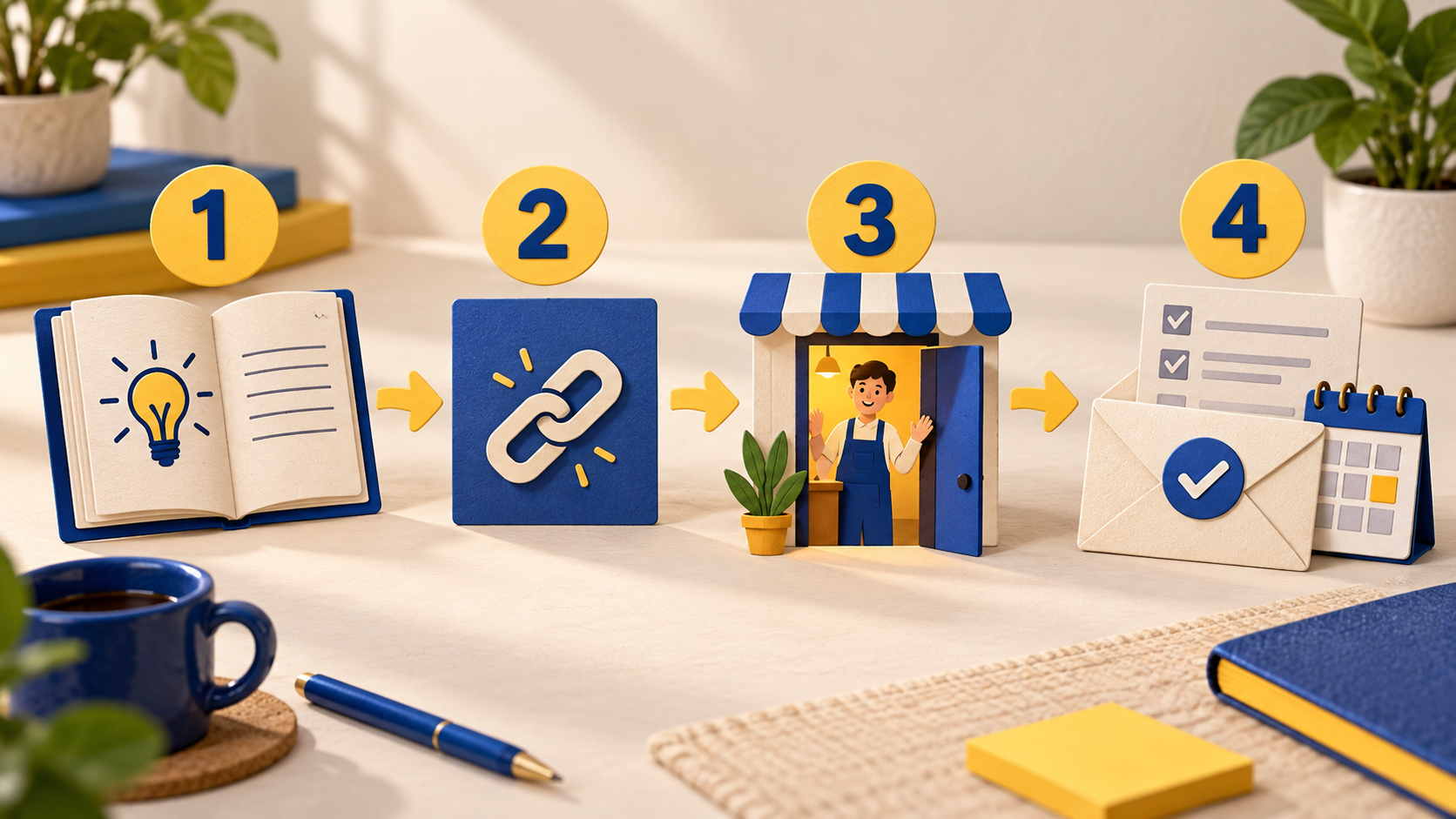
Start with one useful answer
To write your first useful affiliate blog post, choose one reader, solve one small problem, show your reasoning, and recommend a product only where it helps. Finish that first tutorial as a draft with a useful image, a clear disclosure and checked links. A recommendation may earn a commission when it meets the provider’s conditions; writing an article or getting a click does not guarantee income.
An empty blog can make you think you need fifty articles, a perfect logo and a long list of tools. A better first deliverable is something you can point to: “This page helps a solo cleaner decide what to put on an inquiry form.”
This guide takes that one article from an idea to a draft someone can use. The cleaning business is an original fictional practice example. The suggested form is a plan, not a working form or a tested customer result. You will also get a worksheet for your own topic. Domain, hosting and platform setup are separate jobs; you can plan this first article without buying a new stack of tools.
1. Choose a job the reader can finish
Write this sentence before opening an AI tool:
“After reading this, a solo home cleaner can choose the first questions for a cleaning inquiry form and explain what happens after someone sends it.”
That sentence gives the article a finish line. “Learn online business” does not. Neither does “Discover the best tools.” A narrow question lets you decide which examples belong and which paragraphs can go.
| Broad starting idea | Useful first article | The reader leaves with |
|---|---|---|
| Marketing for cleaners | What should a cleaning inquiry form ask? | A short field list and confirmation message |
| Email marketing | What should the first email after a worksheet download say? | A welcome-email outline |
| AI for business | How do you check an AI-written service description? | A claim-by-claim review checklist |
Choose a task you can explain responsibly. If you have not used a product, you can write a documented planning guide. You cannot honestly call it your tested review. For broader audience and storytelling advice, use the existing affiliate content guide.
2. Check what the searcher is asking
Search the question in ordinary language. Open several relevant results and note what they deliver: a finished template, a list of fields, a product comparison or a setup walkthrough. This is search intent: the thing the person wants to accomplish.
For this example, searches about cleaning inquiry forms surfaced editable templates and explanations of what to ask. That supports showing an actual field plan. It does not establish search volume, easy rankings or a winning keyword.
Write three notes:
- They came for: questions they can put on a first-inquiry form.
- They may confuse it with: a detailed job quote or a confirmed booking.
- Our useful addition: why each question belongs, what can wait, and honest confirmation wording.
A keyword tool can help collect ideas, but a “low difficulty” label is an estimate from that tool. It does not show that your page will rank. Keep the exact phrase and date in your worksheet without inventing traffic numbers.
3. Collect the evidence before the draft
Keep a small evidence sheet beside the article. Give each important claim a source or an honest label. Here is what that looks like for our fictional tutorial:
| Statement | What supports it? | How to write it |
|---|---|---|
| HighLevel has a form builder with contact and custom fields. | Current official help guide | “HighLevel documents…” with a source link |
| Start with a service area rather than a full address. | Our example’s first-response goal | “For this fictional example, we would…” |
| The form saves submissions correctly. | A recorded check of the actual form | Leave unclaimed until checked |
| This shorter form gets more customers. | Relevant measured results | Remove; no such results are supplied |
The official HighLevel contact-form guide documents fields, confirmation behavior and submission review. It supports describing those features. It does not prove that our imagined cleaning business configured them successfully.
Save the source URL, the specific fact, the date checked and any limitation. A sales page can establish its advertised offer; it cannot establish that every customer got the advertised result.
4. Use an outline that delivers the answer
Here is the complete outline for the example article. Each section earns its place by helping the cleaner make the form.
Original sample article outline
What Should a Cleaning Inquiry Form Ask? A Simple First-Contact Example
- Quick answer: collect enough to decide whether and how to reply.
- Copy the field plan: name, reply email, service area, type of clean and a short message.
- Understand each question: what decision its answer helps you make.
- Leave these for later: details needed for a final quote or an approved visit.
- Write the confirmation: acknowledge the request without confirming a price or appointment.
- Check the real form: labels, required fields, received information and confirmation.
- Choose your next step: adapt the plan in a tool you already use; explore another only if needed.
Notice what is absent: a long history of cleaning, ten unrelated products and a claim that software will find customers. The tutorial stays useful even if the reader never clicks a paid recommendation.
The example field plan
Proposed field → decision it helps
- Name
- What the cleaner should call the person.
- Reply email
- Where to answer this request.
- Town or service area
- Whether the inquiry is within the area the cleaner serves.
- Type of clean
- Regular, deep clean, move-out or “not sure”; match the options to actual services.
- Short message
- What the person wants to ask.
In this example, a preferred date and phone number can be optional. A full address, access instructions and more detailed job questions can wait for the appropriate next conversation. The owner should decide what the real service needs and how personal information will be handled. This field plan is not a privacy or consent policy.
A sample confirmation could say: “Thanks for your inquiry. We will review your message and reply using the email you provided. This request does not confirm a booking or a final price.” Add a response window only if the business can actually meet it.
5. Replace vague advice with a usable example
Before: advice with no next action
“Create an optimized lead-generation form that captures important customer information and improves your business efficiency. Use automation to streamline the process.”
After: an original answer a beginner can use
“For this first-inquiry example, start with name, reply email, town, type of clean and a short message. Town helps you decide whether you serve the area. The service choice helps you route the question. Do not label the button ‘Book now’ if you are only collecting requests; ‘Send my cleaning inquiry’ describes what it does.
After submission, show a confirmation that explains the next step. Then try the actual form with fictional details and a reply address you control. Check that the saved entry matches what you typed and that the confirmation appears. Record what happened before saying the form works.”
The second version gives a choice, a reason, suggested wording and a check. It makes no claim that we built or ran the form. Use the same editing test on your own paragraph: what can the reader do now that they could not do before?
6. Give AI a brief it can follow
AI can help organize notes, suggest headings and make a dense paragraph easier to read. Give it your evidence and the job sentence rather than asking for “a blog that ranks.”
A reusable drafting prompt
“Help draft one tutorial for [reader] who wants to [finish this task]. Use only the supplied notes and sources. Separate documented facts from original suggestions and actual observations. Do not invent personal use, screenshots, quotes, prices, tests or results. Give the answer first, explain each step and include one concrete example. Mark unsupported claims [CHECK] rather than filling gaps. Finish with one relevant next action.”
Google’s current AI-content guidance allows for useful research and structure assistance while emphasizing accuracy, relevance and manual review. A “humanize” button does not replace checking the facts.
Google’s spam policies distinguish useful affiliate content from copied merchant descriptions and warn about generating many low-value pages to manipulate rankings. Rewording the same answer for dozens of similar searches is not a useful expansion plan.
Read the finished draft yourself. Open its source links. Remove any sentence that sounds impressive but does not help complete the task. Google does not prescribe a preferred word count; length should follow what the answer needs.
7. Add visuals that explain the work
Plan the media before calling the article finished. Our sample tutorial would benefit from:
- A labeled field diagram: show the proposed questions and explain that it is an illustration.
- An actual screenshot, when available: show the real builder or received test entry with private details removed, identifying what it demonstrates.
- A confirmation example: put the suggested wording beside the step it explains.
A decorative robot adds less here than a readable form plan. An AI-created interface must not be presented as proof of a live account or a successful test. Describe the image in its alt text and give it a caption when the distinction matters.
Embed a video when it teaches the same task. Watch it, identify the relevant part and provide a direct-watch link. A general money-making video does not answer which fields this cleaning form should ask for.
8. Put the recommendation where it solves a problem
After explaining the field plan, the natural product question is: “Where can I build this?” Let readers use a suitable tool they already have. If they need a form builder, explain what to check: fields, submission storage, confirmation behavior, running cost and the ability to perform their own test.
The FTC’s affiliate disclosure guidance calls for a clear explanation of the financial relationship near the recommendation. “Affiliate link” by itself may not explain it to a beginner. Keep the plain statement visible rather than relying only on a footer.
If your topic is local AI services, learning the task matters before teaching it. You can explore the AI Agency Blueprint, my own training product, for that separate learning path. It is not required to write this article and does not replace your own evidence. For joining an affiliate program or understanding qualifying purchases, see the HighLevel affiliate program guide.
9. Assemble a real draft, including its preview
In WordPress, create a post and save it as a draft while reviewing. Use the post title for the main heading; preview the actual theme to catch duplicate titles. Add the article, its contextual images and the worksheet link.
The WordPress post settings include featured image, excerpt and status. An image inside the article is not automatically the featured image. The theme also determines how the featured image and excerpt appear on an archive.
- Title: describe the exact answer, without an unsupported result.
- Short URL: something like
/cleaning-inquiry-form-questions/, if available. - Search description: “See a simple cleaning inquiry form plan, why each field belongs, what can wait, and a confirmation message to adapt.”
- Featured image and excerpt: give the blog card a relevant picture and a useful summary.
- Internal link: connect to the next genuinely helpful article.
- Author and review date: identify who is responsible and when the information was checked.
Google’s SEO starter guide supports descriptive titles, useful links and relevant images. It also explains that search snippets can come from the page itself, so your saved description is not a guaranteed Google snippet.
Open desktop and phone previews. Check the blog card, every image, table, download and recommendation destination. Keep expected and observed results separate. A successful page visit does not verify an affiliate conversion.
10. Finish this answer before expanding the library
Ask another beginner to follow the draft. Where do they stop? If they cannot tell an inquiry from a booking, improve that explanation. If they cannot read the field diagram on a phone, fix the diagram.
After a post is publicly available and your site is set up for it, Search Console’s performance report can show recorded search queries, impressions and clicks. Those are different from useful reader outcomes, affiliate purchases and payouts. No traffic, ranking, timing or earnings result is promised here.
Keep a simple update record: what changed, why, the source checked and the check repeated. Add a second article when it answers a genuinely different next question. If the existing page already owns the answer, improve it instead.
Use it for your own example
Save the editable worksheet
Includes the worked example, a blank plan and separate expected-versus-observed checks. No purchase or account is needed for this download.
Download the worksheetRead the complete worksheet here
ONE USEFUL AFFILIATE ARTICLE
An original editable production worksheet, October 12, 2026

Purpose: take one specific reader question from a brief to a checked draft.
Use this in a text editor or print it. No account, form submission or paid
tool is needed to complete the plan. The worked example is fictional.
No traffic, rankings, tests, purchases or earnings are filled in for you.

Do not enter passwords, private customer details, payment information or
another person's unpublished material here. Use fictional practice data.

1. GIVE THE ARTICLE ONE JOB

Reader:
Their starting question:
After reading this, the reader can:
What they do NOT need this page to cover:
What I know about this task:
What I still need to learn:

Choose the honest article type:
[ ] Documented planning guide
[ ] Original example / worksheet
[ ] Actual walkthrough with my recorded checks
[ ] Firsthand review with evidence of my own use
[ ] Other (explain):

Do not choose “Actual walkthrough with my recorded checks” or “Firsthand
review with evidence of my own use” merely because an AI draft uses first
person.

2. CHECK THE QUESTION AND EXISTING PAGES

Search date:
Search country/language, if known:
Exact query used:
Relevant results inspected (URL / what the searcher gets):
1.
2.
3.

Does the searcher want steps, a template, a comparison, or an answer?
What would leave the reader still stuck?
What original help will this page add?
Existing page on my site that already answers this:
Decision: improve the existing page / write a distinct new page / defer
Why:

Optional keyword-tool estimate:
Tool / date / metric name / estimate:
Do NOT turn an estimate into a verified ranking, demand or income claim.

3. BUILD A SMALL EVIDENCE SHEET

For each important claim, fill in:

Claim:
Kind: official documented fact / original suggestion / actual observation
Source URL or evidence file:
Specific support:
Date checked:
Limitation or condition:
Wording I can honestly use:
Wording I must remove:

Claim:
Kind:
Source URL or evidence file:
Specific support:
Date checked:
Limitation or condition:
Wording I can honestly use:
Wording I must remove:

Claim:
Kind:
Source URL or evidence file:
Specific support:
Date checked:
Limitation or condition:
Wording I can honestly use:
Wording I must remove:

4. WRITE THE OUTLINE BEFORE THE FULL DRAFT

Exact working title:
Quick answer (two or three sentences):
Step 1 / reader action / reason:
Step 2 / reader action / reason:
Step 3 / reader action / reason:
Concrete example:
Common mistake and fix:
How the reader checks their own work:
One next action:

BEFORE / AFTER EDIT
Vague paragraph I want to fix:
Specific version with an action, a reason, an example and a check:
What can the reader now do?

OPTIONAL AI DRAFTING PROMPT
Help draft one tutorial for [reader] who wants to [finish this task]. Use
only the supplied notes and sources. Separate documented facts from
original suggestions and actual observations. Do not invent personal use,
screenshots, quotes, prices, tests or results. Give the answer first,
explain each step and include one concrete example. Mark unsupported
claims [CHECK] rather than filling gaps. Finish with one relevant next
action.

5. PLAN MEDIA THAT HELPS THE READER

Hero / blog-card image:
What it communicates:
Actual screenshot / original illustration / other:
Alt text:
Caption, if needed:

In-article diagram or screenshot:
Which step it explains:
What it proves (if anything):
Original file / rights or permission:
Private details removed:
Phone legibility check still needed:

Optional video:
Exact URL / creator:
Same task as this article? Explain:
Relevant section:
What I actually watched:
Direct-watch fallback:
No exact matching video? Leave it out rather than adding filler.

6. PLACE PRODUCTS AND LINKS FOR A REASON

Task that makes a tool useful:
Can the reader use a tool they already have?
Product's relevant documented capability:
Official support source:
Limits, running costs or access conditions to explain:

Link location / relationship / exact intended URL / visible disclosure:
1.
2.
3.

For an affiliate link, say plainly that you may earn a commission.
Put the explanation near the recommendation. Use the approved link from
your own affiliate account for your own site; do not edit another person's
tracking code to invent one. Follow that program's current rules.
Mark paid affiliate links appropriately, such as rel="sponsored".
For your own product, explain that it is yours and why it fits this task.

7. ASSEMBLE THE DRAFT AND THE BLOG CARD

Post title:
Short URL candidate (check availability):
Search title:
Search description:
Featured image file / media ID if known:
Full excerpt (a useful preview, not just the title):
Author:
Actual review date:
Relevant internal article / exact destination:
Draft location:

An in-article image is not automatically the featured image.
How cards and excerpts appear depends on the theme. Inspect the actual
blog index and phone preview. A private draft is not a public article.
Do not invent a publication date or claim a search result exists.

8. RECORD EXPECTED AND OBSERVED RESULTS SEPARATELY

Leave Observed blank until you actually perform the check.
Write not tested, failed or passed with evidence; do not assume success.

Check: the answer matches the title
Expected:
Observed:
Evidence/date:
Action needed:

Check: phone and desktop headings, body and tables are readable
Expected:
Observed:
Evidence/date:
Action needed:

Check: hero, blog-card and in-article images load and explain their role
Expected:
Observed:
Evidence/date:
Action needed:

Check: worksheet download opens and matches the intended file
Expected:
Observed:
Evidence/date:
Action needed:

Check: source, internal and product links open intended destinations
Expected:
Observed:
Evidence/date:
Action needed:

Check: affiliate disclosure is visible by the recommendation
Expected:
Observed:
Evidence/date:
Action needed:

Check: optional video actually plays and has a fallback
Expected:
Observed:
Evidence/date:
Action needed:

Opening a product page checks navigation only. It does not prove referral
attribution, qualification, purchase or payout. Do not make a self-referral
purchase to test an affiliate program. Follow the provider's test process.

9. ORIGINAL WORKED PLAN, FICTIONAL, NOT A COMPLETED TEST

Reader: a solo home cleaner preparing a first-inquiry form.
Question: What should the form ask before we reply?
Finish line: choose a short field plan and explain the next step.
Out of scope: final quote, visit booking, legal privacy/consent policy.

Sample title:
What Should a Cleaning Inquiry Form Ask? A Simple First-Contact Example

Outline:
1. Quick answer: collect enough to decide whether and how to reply.
2. Field plan: name, reply email, town/service area, clean type, message.
3. Why each belongs: identify the person, reply route, service fit and need.
4. What can wait: detailed quote or approved-visit information.
5. Confirmation: acknowledge the request without confirming a booking.
6. Real-form checks: labels, required fields, saved entry, confirmation.
7. Next step: adapt the plan in a suitable tool, then check it yourself.

Original proposed field plan:
- Name: what should we call you?
- Reply email: where should we answer this request?
- Town or service area: do we serve that area?
- Type of clean: regular, deep clean, move-out, not sure (adapt to services).
- Short message: what would you like to ask?
- Preferred date and phone: optional for this example's first response.

Sample confirmation:
Thanks for your inquiry. We will review your message and reply using the
email you provided. This request does not confirm a booking or a final
price.

Add a response time only if the actual business can meet it. The owner
must determine necessary questions and appropriate privacy/consent terms.

Evidence example:
HighLevel's official contact-form guide documents fields, confirmation
behavior and reviewing submissions:
https://help.gohighlevel.com/support/solutions/articles/155000004549-how-to-create-and-manage-a-contact-form-in-highlevel
Checked for the accompanying article: October 12, 2026.
This supports a documented feature description, not a successful account
setup, a cleaning-business result or a conversion-rate claim.

Proposed practice check (NOT performed):
Expected: a test with fictional details and a reply address I control
appears in the actual form's submissions; confirmation explains the next
step without promising a booking.
Observed:
Evidence/date:
Action needed:

10. UPDATE THE ANSWER, THEN CHOOSE THE NEXT QUESTION

What changed:
Why the reader needed the change:
Source/evidence checked:
Check repeated / observed result:
Actual review date:

Different next question:
Existing article that may already answer it:
Decision and reason:

After authorized public publication and setup, Search Console can report
search queries, impressions and clicks. Keep those separate from reader
feedback, affiliate purchases and payouts. Do not fill in predicted
traffic, easy rankings or earnings as if they happened.
Start by filling in the worksheet’s first line: “After reading this, my reader can…” Then write the answer that earns the rest of the page.
Sources and what was checked
Current primary documentation was checked October 12, 2026, except where a source is explicitly dated earlier. The examples and illustrations are original learning aids. No live platform setup, call, billing, signup, purchase, traffic or income result was tested for these articles.
- Creating helpful, reliable, people-first contentChecked 2026-10-12 · Primary source or explicitly dated offer record.
- Google Search guidance on generative AI contentChecked 2026-10-12 · Primary source or explicitly dated offer record.
- Spam policies for Google web searchChecked 2026-10-12 · Primary source or explicitly dated offer record.
- Google SEO Starter GuideChecked 2026-10-12 · Primary source or explicitly dated offer record.
- WordPress Page/Post Settings sidebarChecked 2026-10-12 · Primary source or explicitly dated offer record.
- WordPress Block EditorChecked 2026-10-12 · Primary source or explicitly dated offer record.
- FTC Endorsement Guides: What People Are Asking, Affiliate or Network MarketingChecked 2026-10-12 · Primary source or explicitly dated offer record.
- How to Create and Manage a Contact Form in HighLevelChecked 2026-10-12 · Primary source or explicitly dated offer record.
- HighLevel + Jonathan MontoyaChecked 2026-10-12 · Primary source or explicitly dated offer record.
- Search Console Performance report, Search resultsChecked 2026-10-12 · Primary source or explicitly dated offer record.
- AI Agency Blueprint, owned-product destinationChecked 2026-10-11 · Primary source or explicitly dated offer record.
Frequently asked questions
Can a beginner start an affiliate blog with no audience?
Yes. A blog can start with zero audience because search traffic comes from people looking for answers, not from followers. It takes time to build.
How do I pick my first blog post topic?
Pick one specific question a beginner in your niche searches for, that you can answer from real experience, and that relates to a product you trust.
Can I use AI to write affiliate blog posts?
AI can help with outlines and first drafts. Add your own testing, screenshots, and opinions, and fact check everything before you publish.