
AI Voice · Review
Synthflow builds AI phone agents for big companies. Its pricing page now lists one plan, and it starts at $30,000 a year. Here is what you get and who should look elsewhere.
Synthflow is a voice AI platform. It builds AI agents that answer and make phone calls for businesses.
You may have seen it described as a low cost tool for small agencies. On October 23, 2026, I checked its website, pricing page, and docs. Things have changed. Here is what Synthflow does today, what it costs, and what to use instead if you are small.
Quick answer
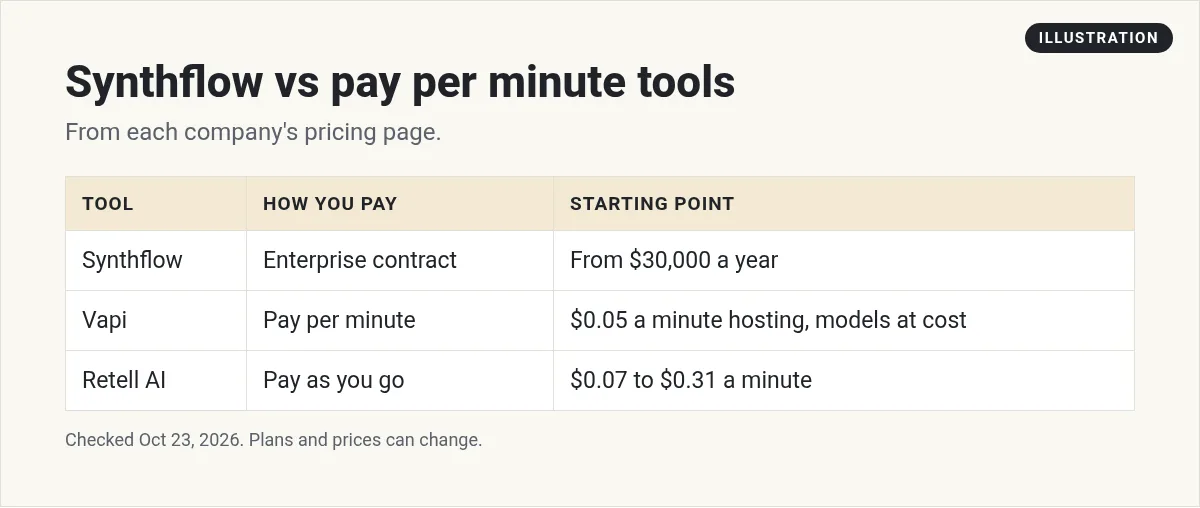
Synthflow is an AI voice platform for building phone and chat agents. On October 23, 2026, its pricing page listed only an Enterprise plan, with contracts starting at $30,000 a year. Final pricing depended on call volume, concurrency, telephony, integrations, security, and launch support. Small teams may want a pay per minute tool like Vapi or Retell AI instead.
What is Synthflow?
Synthflow is a platform for building AI voice agents. A voice agent is an AI that talks on the phone. It can answer calls, book meetings, answer questions, and pass the call to a person.
Synthflow's docs say it lets you build, test, launch, and improve voice and chat agents. It is not just phone calls. The same agent can also run as a chat on a website or app.
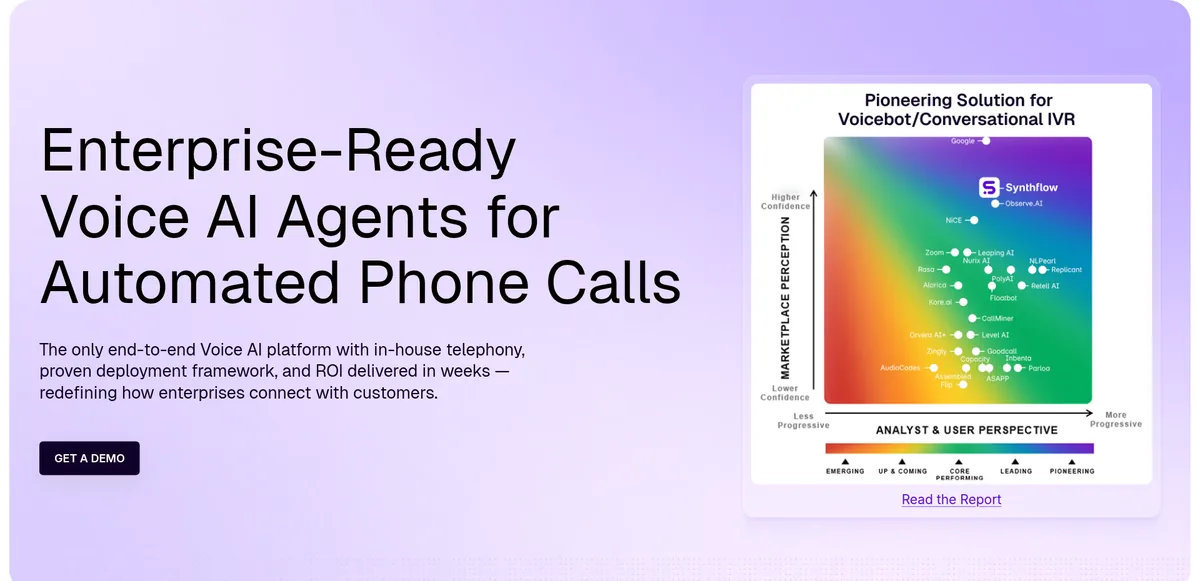
Its pricing page says Synthflow powers over 65 million voice calls every month in 30+ countries. That tells you who it is built for: companies with a lot of calls.
How much does Synthflow cost?
This is the big change. On October 23, 2026, the Synthflow pricing page showed one plan: Enterprise.
The page said enterprise contracts start at $30,000 a year. It also said the final price is scoped around:
- Call volume
- Concurrency, which means how many calls run at the same time
- Telephony setup
- Integrations
- Security needs
- Launch support
There was no self serve plan and no per minute price on the page. To get a real quote, you talk to sales.
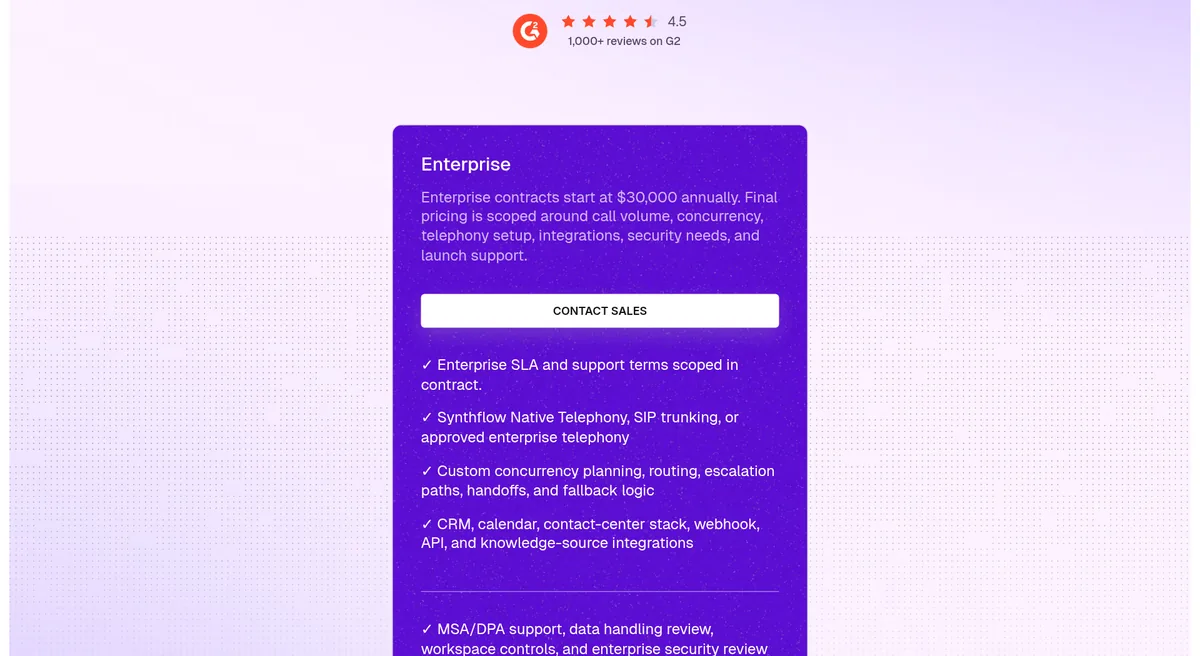
So if you saw an old video or blog post with a low monthly Synthflow price, check the pricing page yourself. On the day I checked, it was enterprise only.
What the Enterprise plan includes
The pricing page listed what comes with an Enterprise contract:
- Enterprise support terms, set in the contract
- Synthflow's own phone network, SIP trunking, or approved enterprise telephony
- Custom planning for concurrency, routing, escalation, and handoffs
- Integrations with your CRM, calendar, contact center tools, webhooks, and API
- Help with contracts like an MSA and DPA, plus a security review
- Setup, onboarding, testing, training, and launch support
In short, you are not just buying software. You are buying a team to help you roll it out.
How Synthflow works: the BELL framework
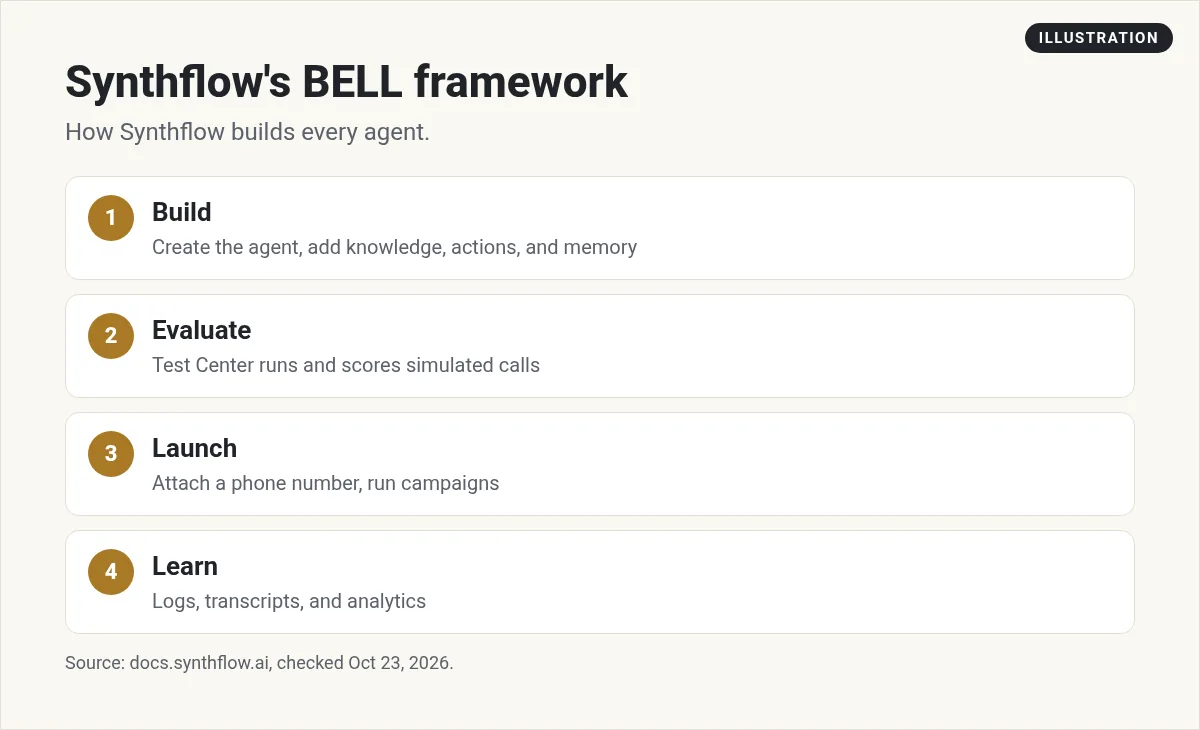
Synthflow builds every agent around what it calls the BELL framework. BELL stands for Build, Evaluate, Launch, and Learn.
- Build. You create the agent. Synthflow's docs say you can describe your agent to Aurora, its built in assistant, and it builds the first version. You can add a Knowledge Base, Actions like call transfers and booking meetings, and Memory to remember contacts.
- Evaluate. You test it. The Test Center runs simulated conversations and scores them, so you catch problems before real callers do.
- Launch. You buy or import a phone number and attach it to the agent. Campaigns let you call a list of contacts in one batch.
- Learn. You watch the results. Logs show every call with its transcript and recording, and analytics track quality over time.
Other features worth knowing
- Own phone network. The home page says Synthflow runs its own telephony, and you can still connect your own carriers or SIP trunks.
- Integrations. Its site lists Cal.com, GoHighLevel, HubSpot, Salesforce, and Zapier, among others.
- Whitelabeling. The docs cover setting up subaccounts under your own brand.
- Concurrency docs. There is a page on call limits and capacity, which matters when you run many calls at once.
Security and compliance
If you work in health care, finance, or insurance, this part matters most. Synthflow's home page says its setup is certified for SOC 2, HIPAA, PCI DSS, and GDPR. It also lists full encryption, audit logs, and region based hosting.
The home page also says its agents follow set logic and approved knowledge sources. Even so, test your agent with real questions before it talks to customers. No AI tool is perfect, and you are the one who answers for what it says.
Call speed and uptime
Voice agents feel natural only when they reply fast. Long pauses make callers hang up. Synthflow's home page says its own phone network keeps latency below 100 ms and uptime above 99.99%.
It also says it connects with enterprise phone systems like Cisco, Avaya, Genesys, and RingCentral. And you can keep your existing SIP or PBX setup. Those are Synthflow's own claims, so ask for proof during a sales call if this matters to you.
What businesses use Synthflow for
The home page lists use cases by industry. Here are a few:
- Customer support. Handle tier 1 questions and overflow calls.
- Online stores. Answer order tracking and common questions.
- Insurance and finance. Verify callers and take claims or account requests.
- Real estate. Answer property questions, qualify leads, and book viewings, even after hours.
- Health care. Book appointments and route calls around the clock.
Pick one simple job first. A single, clear task is much easier to test than an agent that tries to do everything.
Tools for building and fixing agents
The home page also describes a visual Flow Designer. You map out each step of a call and connect it to your other apps through APIs. Subflows act like small agents that handle one task each.
There is version control too. You can preview, compare, and roll back changes to an agent without downtime. Real time views show every call, webhook, and API request, which helps you find bugs faster.
Who is Synthflow good for?
Synthflow fits if you:
- Run a large company or call center with high call volume.
- Need security reviews, contracts, and an uptime promise.
- Want hands on help with setup and launch.
- Have a budget that starts at $30,000 a year.
Look elsewhere if you:
- Are a solo builder or a small agency.
- Want to test an idea for a few dollars first.
- Want to pay per minute instead of signing a contract.
Simpler options for small teams
If Synthflow is too big for you right now, here are tools I checked on the same day that let you start small:
- Vapi: $0.05 a minute for hosting, with AI models at cost and $5 in free credits. Good if you like to pick each part.
- Retell AI: pay as you go from $0.07 to $0.31 a minute, with $10 in free credits. See my Retell AI guide.
- HighLevel Voice AI: built into HighLevel, if you already use it. See my post on HighLevel Voice AI cost.
My video: How I think about AI voice agents for local businesses.
Any results mentioned in videos are not typical and are not a promise of income. Your results depend on your work and your market.
Know the rules before you make calls
In the US, the FCC ruled that AI voices in robocalls count as artificial under the Telephone Consumer Protection Act. So the same consent rules apply.
Answering calls is one thing. Calling people with an AI voice is another. Get the right consent before you make outbound calls, and talk to a lawyer if you are not sure.
The bottom line
Synthflow is a serious voice AI platform with its own phone network, testing tools, and launch support. But today it is priced for big companies, starting at $30,000 a year.
If that is you, book a demo and ask for a quote based on your call volume. If not, start with a pay per minute tool and grow from there. My AI receptionist software guide is a good next read. And if you want to see how people turn voice agents into a service for local businesses, I cover it in my free AI workshop.
Want to build AI tools for local businesses?
In my free workshop, I show how regular people use AI tools, like voice agents, to help businesses and build simple online income streams.
Join my free AI workshopFree to join. No credit card needed.
Frequently asked questions
How much does Synthflow cost?
On October 23, 2026, Synthflow's pricing page listed only an Enterprise plan, with contracts starting at $30,000 a year. Final pricing depends on call volume, concurrency, telephony, integrations, security, and launch support.
Does Synthflow have a free plan?
Its pricing page did not show a free or self serve plan on October 23, 2026. It showed one Enterprise plan with a Contact Sales button.
Does Synthflow work with GoHighLevel?
Yes. GoHighLevel is in the integrations list on Synthflow's website, along with HubSpot, Salesforce, Cal.com, and Zapier.
What is the Synthflow BELL framework?
BELL stands for Build, Evaluate, Launch, and Learn. It is the loop Synthflow uses to create, test, launch, and improve each agent.
Can I white label Synthflow?
Synthflow's docs include a Whitelabeling section for setting up subaccounts under your brand.
What is a cheaper alternative to Synthflow?
For small teams, pay per minute tools like Vapi and Retell AI let you start with free credits instead of a yearly contract.
Is Synthflow HIPAA compliant?
Synthflow's home page says its setup is certified for SOC 2, HIPAA, PCI DSS, and GDPR. Confirm the details for your use case in a sales call before you handle patient data.
Can I keep my own phone system with Synthflow?
Yes. Synthflow says you can connect your own carriers or SIP trunks and keep your existing SIP or PBX setup.
Sources
Checked October 23, 2026. Plans, prices, and rules can change.
