Pick one useful service
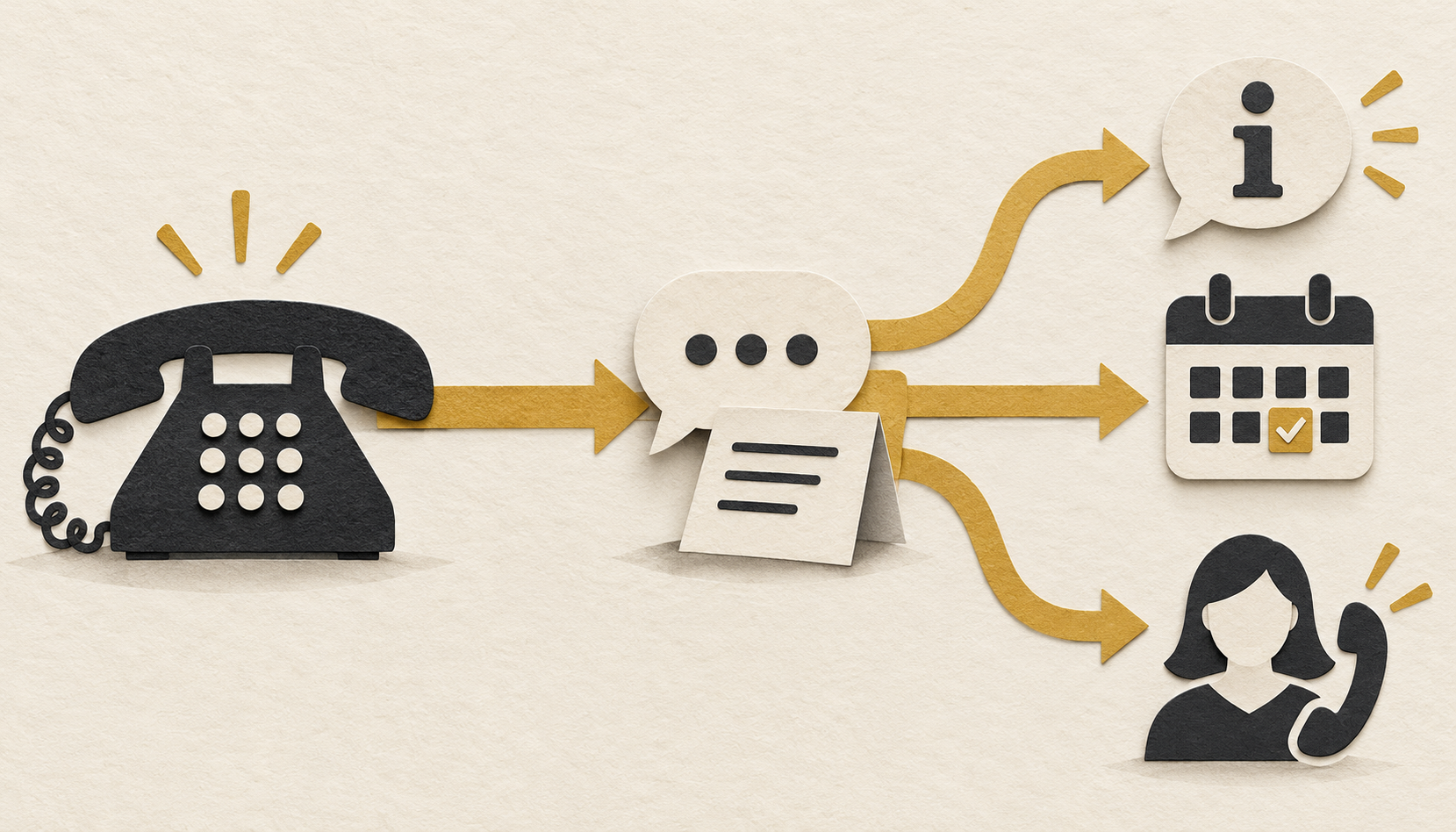
Answer a call. Collect a clearer request. Help someone choose an appointment. These are business jobs an owner can understand and pay you to set up. Compare five simple services, see what each includes, and leave with one clear idea you can explain in a sentence.
A business owner does not need another person saying, “AI is the future.” They need the phone answered while they are working. They need a customer to find the right service. They need tomorrow’s appointment written down correctly.
That gives you a much clearer place to start. Pick one small job that helps a real business serve its customers. Learn how to deliver it with software. Then offer to set it up and look after it.
You do not have to invent the software or understand every AI tool. You do have to understand the job well enough to notice when the software gets it wrong.
What are you actually selling?
An AI service is help completing a business task using AI software. The client is buying your setup, judgment, testing, and ongoing help. Software access may be part of the package, but it is not the whole service.
For example, an AI receptionist is software that answers calls. Your service could be setting it up to answer approved questions, take a caller’s details, and pass those details to the business owner.
“I install AI” leaves the owner guessing. “I help you collect new customer requests when you cannot answer the phone” describes a job they already understand.
The five ideas below overlap. A phone assistant might also book appointments. A website assistant might collect a quote request. That is useful: you can start with one job and add another only when the client needs it.
Video walkthrough · Jonathan Montoya
See one service a business can understand
Start with the call-answering example. Then use the five choices below to pick one clear job you could help with.
This lesson illustrates the process; it does not establish client or income results.
Five services a beginner can understand
1. Help answer incoming phone calls
The problem: someone calls while the owner is driving, meeting a customer, or doing a job. The owner wants a useful message rather than a missed opportunity to speak.
The service: configure a phone assistant with the business’s hours, service area, approved answers, and instructions for passing requests to a person. HighLevel’s current Voice AI supports incoming conversations, collecting information, and routing callers. Those abilities depend on the setup. See HighLevel’s Voice AI overview.
A small first version: answer after hours, ask what the caller needs, confirm their callback number, and notify the owner. Leave pricing and scheduling decisions with the owner until those steps have been tested.
A plain-English offer: “I can set up an assistant that takes new customer requests after hours and sends you the details.”
What you maintain: business information, call rules, the person receiving notifications, and a sample of conversations. Keep an agreed fallback when the assistant cannot help.
This could fit an appointment-based service business with repeat questions. It is a poor first project when every call requires expert judgment or the owner expects the assistant to handle anything a customer might say.
2. Help website visitors get simple answers
The problem: a visitor wants to know whether a business serves their area or offers a particular service. They cannot find the answer quickly.
The service: add a website conversation box that uses owner-approved information and gives the visitor a clear next step. HighLevel documents question answering, collecting details, and human handover across supported channels. Read its Conversation AI setup guide.
A small first version: answer ten common questions and invite the visitor to request a callback. If the information is missing, say so and pass the question to the team.
A plain-English offer: “I can help visitors get answers about your services and leave a clear request for your team.”
What you maintain: service descriptions, hours, contact details, and unanswered questions. Remove outdated offers promptly.
The important question is whether the website receives relevant visitors. A conversation box on a site nobody visits will not create an audience by itself. Ask about traffic and current inquiries before promising a useful improvement.
3. Help customers choose an appointment time
The problem: the team spends time exchanging messages to find an available appointment.
The service: connect an assistant to the business’s booking calendar and define the appointments it is allowed to arrange. HighLevel supports AI-assisted booking against configured calendars; availability and booking rules need to be correct first. See the official booking workflow guide.
A small first version: offer one appointment type, such as a 20-minute estimate call. Keep complicated jobs as callback requests.
A plain-English offer: “I can help customers choose an available estimate-call time without the back-and-forth messages.”
What you maintain: appointment length, breaks, notice periods, staff availability, cancellations, and confirmation messages.
This works best when the business already knows what can be booked. If the owner assigns jobs differently every day, start by collecting requests. A booking assistant needs a reliable calendar, not an optimistic guess.
4. Turn messy quote requests into clear notes
The problem: “How much?” arrives with no description, location, or useful detail. The owner must start the same conversation again.
The service: use an assistant to ask a short, approved set of questions and save the answers for the team. It is gathering information, not inventing a price.
A small first version: collect the customer’s name, preferred contact method, service needed, general location, and preferred timing. Ask only for information the business actually needs.
A plain-English offer: “I can help you receive clearer quote requests so you know what the customer needs before you call back.”
What you maintain: the questions, destination for the notes, and handoff process. Check that the owner can find and use the information.
Some businesses need a simple form for this job. Use one if it solves the problem better. AI earns its place when it helps a visitor clarify their request or answer a relevant follow-up question.
5. Improve a business website with AI-assisted work
The problem: the website does not clearly explain the services, where the business works, or how to request help.
The service: use AI to help prepare clearer page copy and a useful page layout, then verify every business detail with the owner. Your work includes editing and checking the finished page on a phone.
A small first version: improve one service page. Put the service, area, customer questions, and contact step in an order a visitor can follow.
A plain-English offer: “I can make your service page easier to understand and easier to contact you from.”
What you maintain: links, forms, service details, mobile layout, and any ongoing changes included in your agreement.
This is project work unless there is a real ongoing job to do. Do not turn a one-time page improvement into a monthly fee with no clear monthly responsibility. Also, a clearer page does not guarantee rankings, AI recommendations, or sales.
A useful bonus: a text after a missed call
A missed-call reply can be simpler than a full AI phone assistant. HighLevel offers a feature that sends a text after an unanswered call. It is basic automation; the first text does not require an AI conversation. Its documentation also warns that repeat calls can trigger repeat messages unless you control that behavior. See the missed-call text-back guide.
A sensible message might say: “Thanks for calling Example Cleaning. We could not answer just now. What service do you need help with?” The business must have a way to handle the reply. Agree the message, sending setup, and contact permissions with the owner before launch.
Which service should you choose first?
Choose the smallest service that addresses a problem you can verify. Use these three questions:
- Can the owner describe the problem? “We spend an hour a day arranging estimates” is stronger evidence than your guess that they need AI.
- Can you show the improvement? A sample caller request arriving in the right inbox is a clear demonstration.
- Can you deliver the first version reliably? You need enough control to test it, correct it, and explain its limits.
| If the owner says… | Explore… | Confirm first… |
|---|---|---|
| “I cannot answer while working.” | Incoming call capture | Who follows up and when |
| “People keep asking the same questions.” | Website question answering | The answers are approved and current |
| “Scheduling takes too many messages.” | One appointment-booking path | The calendar reflects real availability |
| “Quote requests never include enough detail.” | Simple request collection | The team will use the collected answers |
| “Customers cannot tell what we do.” | One clearer service page | The problem is page clarity, not missing demand |
Try it here · a practical planning tool
Choose a small first service
Start with the customer's need. This tool suggests a manageable first job; it cannot tell you whether a business will buy.
Choose the customer problem first.
Then match it to one small service you can explain and test.
This tool does not submit your entries or store them between visits. Download any notes you want to keep.
If you are ready to try the tools behind your chosen idea, explore HighLevel through Jonathan’s trial page. Build the one feature that matches the job rather than trying every feature at once. Affiliate link: I may earn a commission if you sign up through it. Review the plan and checkout terms; subscription billing starts after the trial unless canceled, and phone, AI, or other usage can cost extra, including during a trial.
A small offer from start to finish
The demonstration is simple: submit a test request, show the summary, and ask the owner whether it contains the details needed for a callback. Success means the request is accurate and reaches the right person. A closed sale is a later business outcome, not proof the assistant alone caused it.
The offer could include setup, owner approval, test requests, and a defined amount of monthly monitoring. Software usage and extra work need clear terms. Before naming a price, calculate your costs and time using the AI service business cost guide.
Fill in your first-service worksheet
Use the download to complete these sentences:
- I want to help [one business type].
- The customer task I want to improve is [one task].
- I have observed [specific evidence]. I still need to ask [question].
- The first version will [three actions at most].
- It will pass the request to [person or place].
- I will test it by [showing a complete customer journey].
- My ongoing job will be [real maintenance responsibility].
If you cannot complete those lines yet, interview an owner before buying more tools. A clearer understanding of the business will improve your next decision more than another feature list.
Your next step
Choose one service and find three owners you can ask about the problem. You are looking for confirmation, not trying to prove every business needs your idea.
Once you have chosen one useful job, use my free AI agency program to learn how to build and offer it. It is my own program. Follow the learning path from practice setup to approaching businesses. Software, usage, and optional purchases are separate.
Take the next step on paper
Choose Your First AI Service Worksheet
A usable worksheet for the task in this guide. Download it, copy the text, or print this page with the worksheet open.
Open the complete worksheet text
CHOOSE YOUR FIRST AI SERVICE
A working sheet. Complete one copy per idea.

1. THE BUSINESS
Business type:
Owner I can ask:
The customer task I want to improve:
What I observed (fact only):
What I still need to ask:

2. THE SMALLEST USEFUL VERSION
The service will do these three things:
1.
2.
3.
The service will NOT promise or decide:
When a person must take over:
Where the customer details will arrive:
Who handles them and when:

3. THE DEMONSTRATION
A normal customer request to test:
An unclear request to test:
A question it must not guess at:
How I will verify the owner received the right information:
What counts as a pass:

4. THE ONGOING JOB
Information to review:
How often to check conversations:
Support and changes included:
Software/usage paid by:
Next owner conversation date:

MY OFFER IN ONE SENTENCE
I help [business type] [complete customer task] by [small service], with [clear human handoff].

Decision: ask more questions / build a private demo / choose a different idea
Reason:
Sources and review notes
Official sources support the specific feature or rule cited beside it in the article. Calculations, worksheets, and fictional examples are editorial planning tools. Software features and prices can change.
- HighLevel Voice AI overviewChecked 2026-10-10
- HighLevel Conversation AI setupChecked 2026-10-10
- HighLevel appointment booking workflowChecked 2026-10-10
- HighLevel missed-call text backChecked 2026-10-10
Frequently asked questions
What AI services do local businesses pay for?
Common ones include AI call answering, missed call text back, appointment booking, review requests, and website chat.
Which AI service is easiest to start with?
Missed call text back or a simple AI receptionist is often the easiest start because the problem is easy to explain.
Do I need technical skills?
Basic skills are enough to start. You need to learn one platform, follow setup steps carefully, and test well.