
Grok Bot · Procurement
The team behind Grok Bot wrote up how they use a Haggle Bot for vendors, renewals, and office supplies. Here is how it works, the rules it follows, and how to copy the idea safely.
Grok Bot for procurement means giving a Bot the boring parts of buying: knowing what you pay for, spotting waste, researching options, and drafting the ask. In a September 4, 2026 post, the x.ai team showed how their own Haggle Bot does this, with people approving anything that goes to a vendor.
I read that post and the Grok Bot docs on November 2, 2026. Here is what the Haggle Bot does, the rules it follows, and how a small business can copy the idea.
TL;DR
The x.ai team's Haggle Bot reads vendor spend, contracts, and usage, then compares market prices and quotes. It is connected to Slack, Notion, Google Drive, Gmail, Hex, and Ramp. It mapped about 125 active vendors, found paid seats nobody had used in 90 days, and preps renewals by pricing other options and drafting the negotiation. Its rules are simple: it may always research and message coworkers, it needs a person's go ahead before contacting a vendor, and it never signs, buys, or commits. You can copy the Haggle Bot from the Bot Marketplace.
What the Haggle Bot does
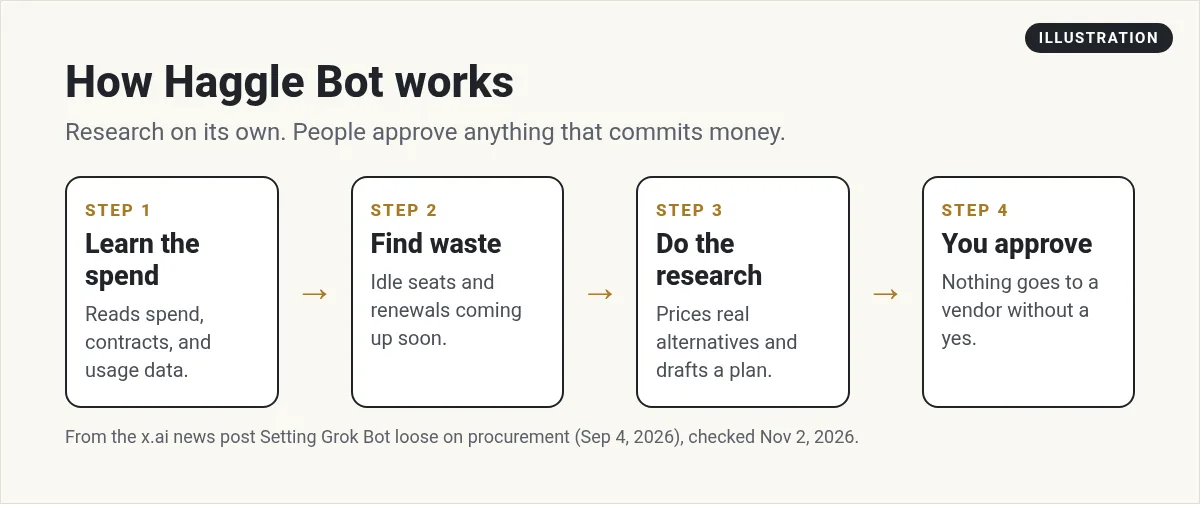
The x.ai post describes a Bot that reads where the money goes. It looks at spend, contracts, and how much each tool is used, then checks market prices and other quotes. It is connected to Slack, Notion, Google Drive, Gmail, Hex, and Ramp.
Its first job was a map. It found about 125 active vendors and asked the same questions for each one:
- Who owns this vendor?
- Why do we need it?
- What else could we use?
- Do we pay for two tools that do the same thing?
- Did the cost jump?
- Are people actually using the seats we pay for?
That last question paid off. For one product, the post says the Bot found 43 paid seats with no activity in 90 days and sent the names back for a person to review. It also took the next step on its own. To learn who owned a vendor, it started with the owners listed in Ramp, messaged them, and followed each handoff until it reached the people who could decide.
The three permission lines
This is the part I would copy first. The post sorts every action into three groups:
- Always allowed: research, and messaging coworkers with questions.
- Needs a person's go ahead: anything sent to a vendor.
- Never: signing, buying, or committing to anything.
Grok Bot has approvals built in, so you can set this up. My Grok Bot safety guide shows how.
How it handles renewals
When a renewal came up, the Bot compared the offer with what they already spent and advised against adding seats nobody had proven they needed. It priced other options and drafted the negotiation. People set the lowest terms they would accept and approve the send. The post is honest that the team still edits its emails for tone. A Bot can be blunt in a way that hurts a vendor relationship.
The supplies run
The same team orders supplies for new hires every Friday. Another Bot, called Amazon Bot, places that order. The Haggle Bot shops it around first. It builds a Google Sheet the office team can edit, for example to change how many new hires are coming. Then it compares prices across Amazon, Costco, Uline, and Walmart, and drafts an email asking their Amazon rep for better prices on some items. Once pricing is settled, it hands the order back to Amazon Bot to send.
For a small business, I would keep one more step: you look at the cart before anything is bought.
How to copy this for a small business
You do not need 125 vendors. Even a small business pays for more tools than it remembers.
- Get the Bot. The post says you can copy the Haggle Bot from the Bot Marketplace. Or make your own Bot and call it Spend Review.
- Give it read access. Connect email and your accounting or card tool. See my Grok Bot connectors guide.
- Ask for the map first. Try this:
Look through my email receipts and card charges from the last 6 months. List every software tool and vendor we pay, how often, who signed up, and when it renews. Flag duplicates and anything nobody seems to use. Do not contact any vendor.
- Check its work. It will miss some and get some wrong. Fix the list.
- Add a renewal routine. Once a month, have it list what renews in the next 60 days. See my Grok Bot routines guide.
- Keep the three lines. Research is fine. Vendor emails need you. Buying and signing stay with people.
Two other takes
A software company connected Grok Bot to an ERP system and had it run a buying cycle from one prompt: check stock, make purchase requests, and ask vendors for quotes.
From the TEKAI by TEKROI channel (not mine): This comes from a company that sells the ERP add on it shows, so treat it as a product demo. Notice it creates real documents in a live system, which is exactly where approvals matter most.
Parker Prompts builds nine everyday Bots, including price monitoring and subscription tracking, which are small versions of the same idea.
From the Parker Prompts channel (not mine): Parker runs a paid AI community and links to it in his description. The subscription tracker part is a good starter for a solo business.
Why this works better than a spreadsheet
Most small businesses track tools in a spreadsheet that goes stale in a month. A Bot with a routine keeps looking. The post says the team is interested in what Bots can do when they stay on the same job over time, because many signals only show up slowly as spend and usage change. A Bot that checks every month will catch the tool that crept up in cost or the seat that went quiet. You still make the call, but you are no longer the one who has to remember to look.
Watch outs
- Private terms. Contracts may say you cannot share terms. Keep the Bot's notes inside your company.
- Wrong numbers. Always check totals against the real invoice.
- Tone. Read every vendor email before it goes.
- Seat counts. A seat that looks unused may belong to someone on leave. Ask the owner first.
Put procurement inside a full team
A Haggle Bot is one seat. A business also needs someone on sales, marketing, and money, and someone to keep them all on track.
AIM Agent is an AI Chief of Staff for business owners. It comes with an AI C-suite (COO, CMO, CFO, CRO and CTO), a Business Bot Builder and 100+ business skills, and it runs on AIM OS, a private vault that holds your notes and memory. AIM Agent is a ready-made AI business team that works inside Grok Bot, so you skip the setup and get to work.
Here is what you get:
- An AI Chief of Staff that helps you plan and run your business
- An AI C-suite: COO, CMO, CFO, CRO and CTO
- A Business Bot for each business or project. Give it a real task and it brings the work back for you to review
- 100+ business skills for content, offers, research and more
- Step by step setup guides and email support
So spend review is one part of a team that already knows your business.
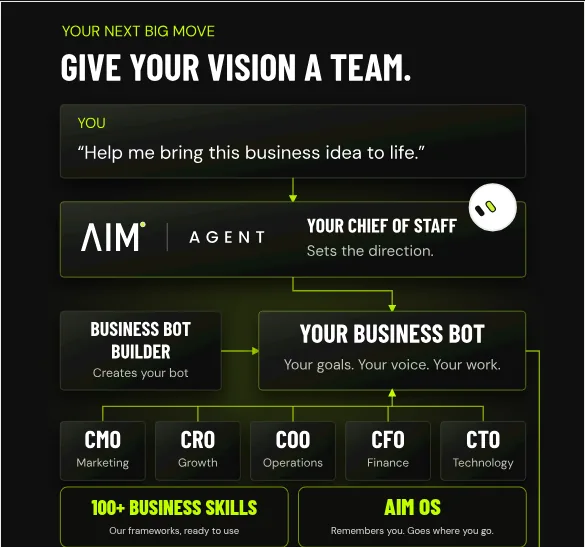
Want an AI team to help run your business? Meet AIM Agent, an AI Chief of Staff for business owners. I am a co-founder of AIM Agent and have a financial interest in the product.
Get a Bot team that watches the whole business
AIM Agent gives you an AI Chief of Staff, an AI C-suite, and 100+ business skills, so spend, sales, and operations all have an owner.
See AIM AgentFrequently asked questions
What is the Grok Bot Haggle Bot?
A procurement Bot the x.ai team uses to map vendors, find waste, prep renewals, and shop supplies. You can copy it from the Bot Marketplace.
Can Grok Bot negotiate with vendors?
It can draft the negotiation. In the x.ai setup, a person sets the terms and approves every vendor email.
Can Grok Bot buy things for me?
In the x.ai setup, the Bot never buys, signs, or commits. Keep it that way.
What apps does the Haggle Bot use?
The post lists Slack, Notion, Google Drive, Gmail, Hex, and Ramp.
Is this useful for a small business?
Yes. Start with a list of every tool you pay for and when it renews.
Does it replace a procurement person?
No. It does the research and drafts. People make the calls.
Is there a faster way to get a Bot team for my business?
AIM Agent gives you an AI Chief of Staff, an AI C-suite, and 100+ business skills, so you start with a team built for business work.
Sources
Checked November 2, 2026. Plans, prices, and rules can change.
