
Affiliate Marketing · Basics
An affiliate link is a special link that tells a company you sent the buyer. Here is how it works, how to get one, and the rules for sharing it the right way.
You may have seen them in YouTube descriptions, blog posts, and emails. A link that looks normal but ends with something like ?ref= and a string of letters. That is an affiliate link.
In this guide I show you what an affiliate link is, the parts of one (using a real link of mine), how to get your own, and what the FTC and Google say about sharing them. I checked both on October 25, 2026.
Quick answer
An affiliate link is a unique web link a company gives you so it can track who you send to its site. If someone clicks your link and buys, the company knows you sent them and pays you a commission, based on its program terms. The link usually has a tag and your partner ID, like ?ref=3jvtifuj. The FTC says you must disclose that you get paid, clearly and close to the link.
What is an affiliate link?
An affiliate link is a normal web link with a tracking code added. The code tells the company that you, the affiliate, sent the visitor.
Here is the flow in plain words:
- You join a company's affiliate program.
- The company gives you a link with your own ID in it.
- You share that link in a post, video, or email.
- Someone clicks it and visits the site.
- If they buy, the company's software sees your ID and credits you.
- The company pays you a commission, based on its program terms.
The buyer usually pays the same price either way. The commission comes from the company, not the buyer. Check each program's terms to be sure.
If you are new to the whole idea, start with my guide on how affiliate marketing works.
Affiliate link vs a normal link
To a reader, an affiliate link works just like a normal link. It opens the same site. The difference is the tracking code at the end.
- A normal link just points to a page. Nobody gets credit.
- An affiliate link points to the same page, but carries your ID, so the company knows you sent the visitor.
That small code is also why the rules below matter. Because you may get paid, your readers have a right to know.
The parts of an affiliate link
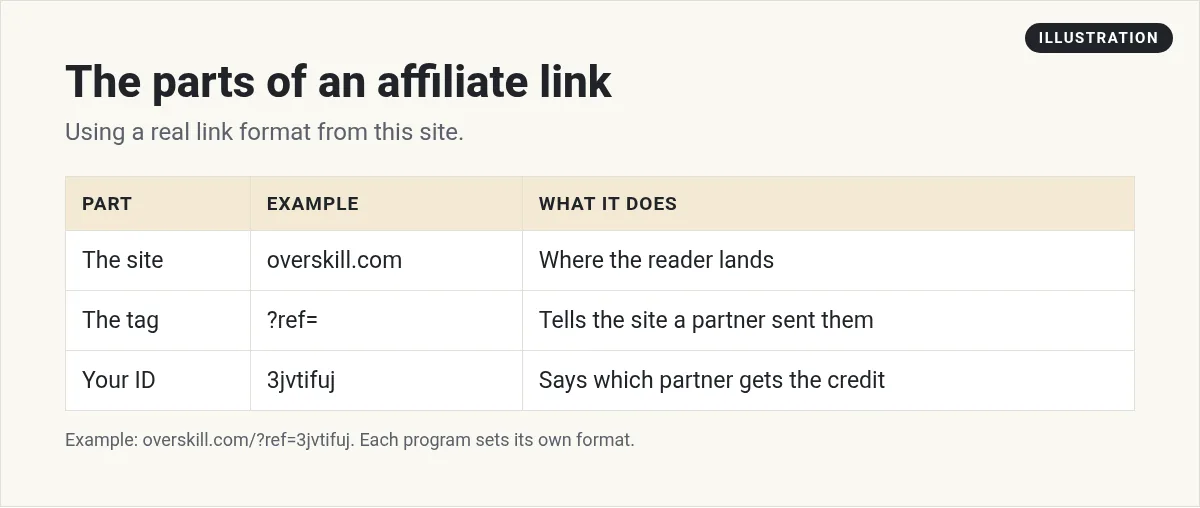
Here is my real Overskill link (I earn a commission if you buy through this link), broken into parts:
https://overskill.com/?ref=3jvtifuj
- The site: overskill.com. This is where the reader lands.
- The tag: ?ref=. This tells the site a partner sent the visitor.
- Your ID: 3jvtifuj. This says which partner gets the credit.
Every program sets its own format. Some use ?ref=, some use ?via= or ?aff=, and some use a short link. The idea is the same.
How do affiliate links track sales?
Programs use affiliate software to do the tracking. For example, FirstPromoter is affiliate software for subscription and SaaS companies. Its docs say it lets a company "track, manage and optimize referral-based marketing programs." Its home page says it can track "links, coupon codes and direct URLs."
When someone clicks your link, the software usually saves a small note in their browser, called a cookie. If they buy later, the software checks for that note and credits you. How long that note lasts depends on the program. Read the terms for the exact window.
Tracking is not perfect. If the buyer clears their browser, uses another device, or blocks cookies, you may not get credit. That is normal, and it is one reason to pick programs with clear terms.
How to get an affiliate link
- Pick a product you use. Share links for tools you would tell a friend about.
- Find the program. Look for "Affiliates" or "Partners" in the site's footer.
- Apply. Some programs approve you right away. Others review your site or channel first.
- Copy your link from the affiliate dashboard.
- Test it. Click it in a private window and make sure it lands on the right page.
Want ideas? See my lists of affiliate programs for beginners and SaaS affiliate programs. If you want to try one I use, I wrote about the Overskill affiliate program.
The FTC rules for affiliate links
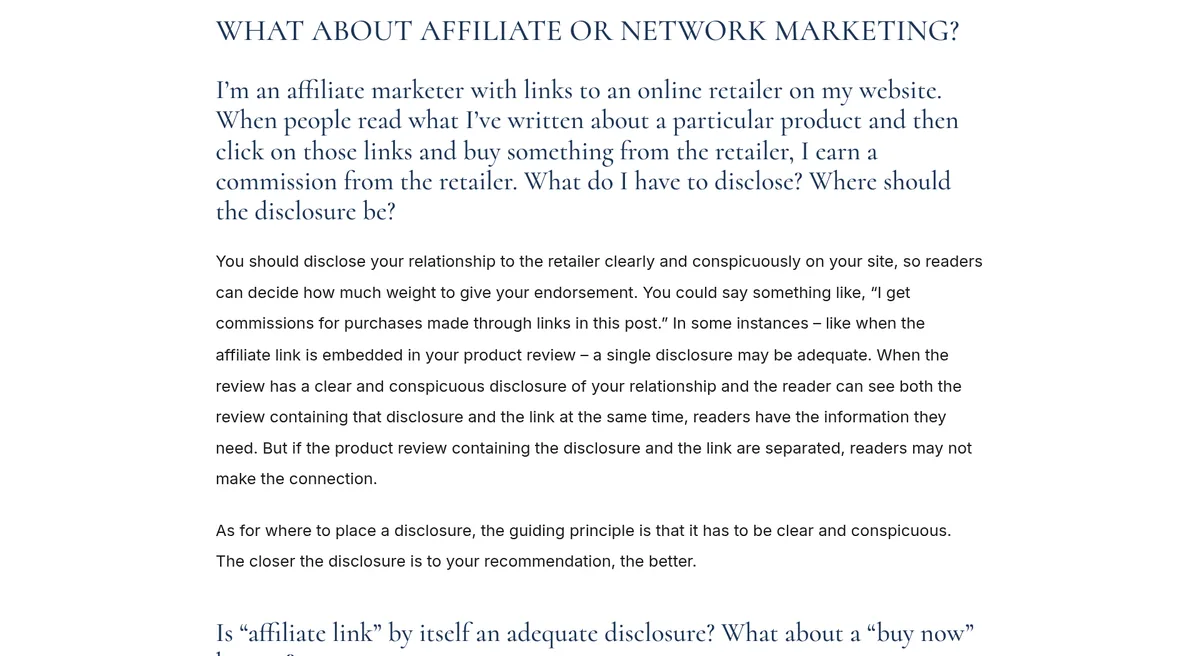
In the US, the FTC says you must tell people when you get paid for a recommendation. Its Q&A page answers affiliate marketers directly.
Here is what it says, in short:
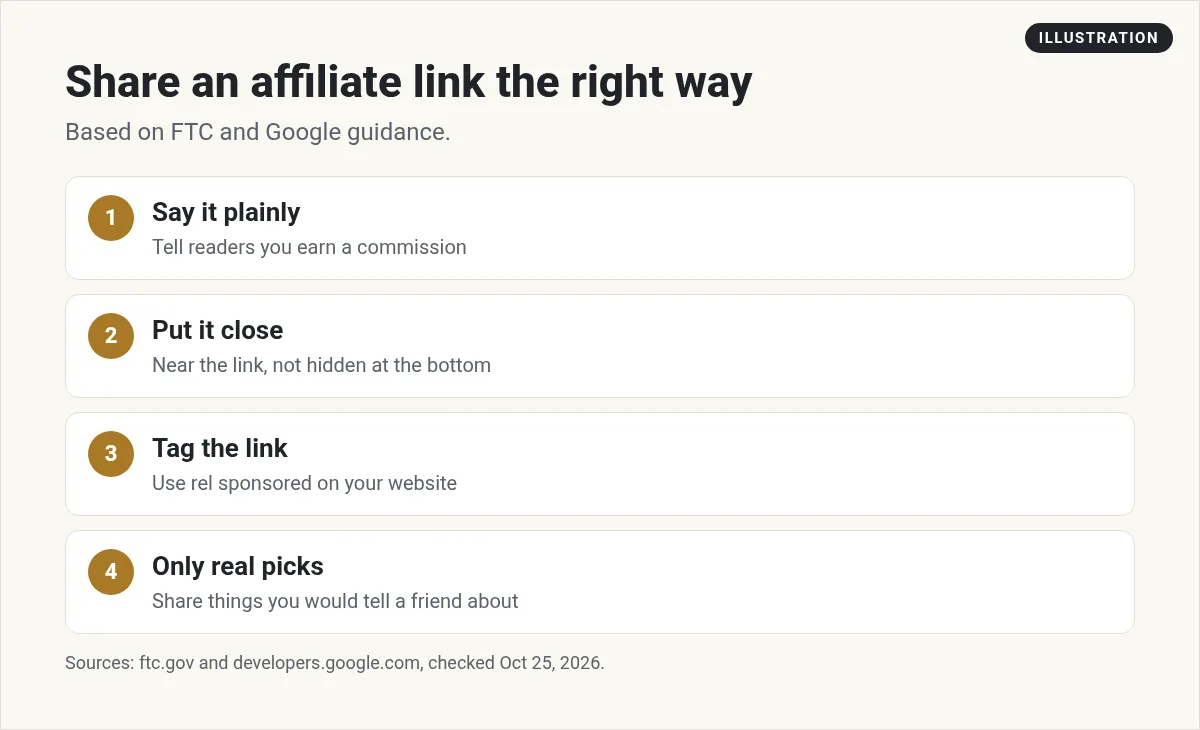
- Disclose clearly. Disclose your relationship "clearly and conspicuously." The FTC gives a sample: "I get commissions for purchases made through links in this post."
- Put it close. "The closer the disclosure is to your recommendation, the better."
- "Affiliate link" alone is not enough. The FTC says people "might not understand" that phrase. A "buy now" button "would not be adequate" either.
- "Paid link" can work. The FTC says "Paid link" right next to an affiliate link "should be an adequate disclosure."
- Skip "commissionable link." The FTC says it "is probably not a clear disclosure."
For YouTube, the FTC says you can put a disclosure in the description, "but that's not enough on its own because consumers can easily miss disclosures in the video description." It says the disclosure has the best chance of being clear if it is "included in the video itself."
This is not legal advice. If you are unsure, read the FTC page in full or ask a lawyer.
Google's rules: use rel="sponsored"
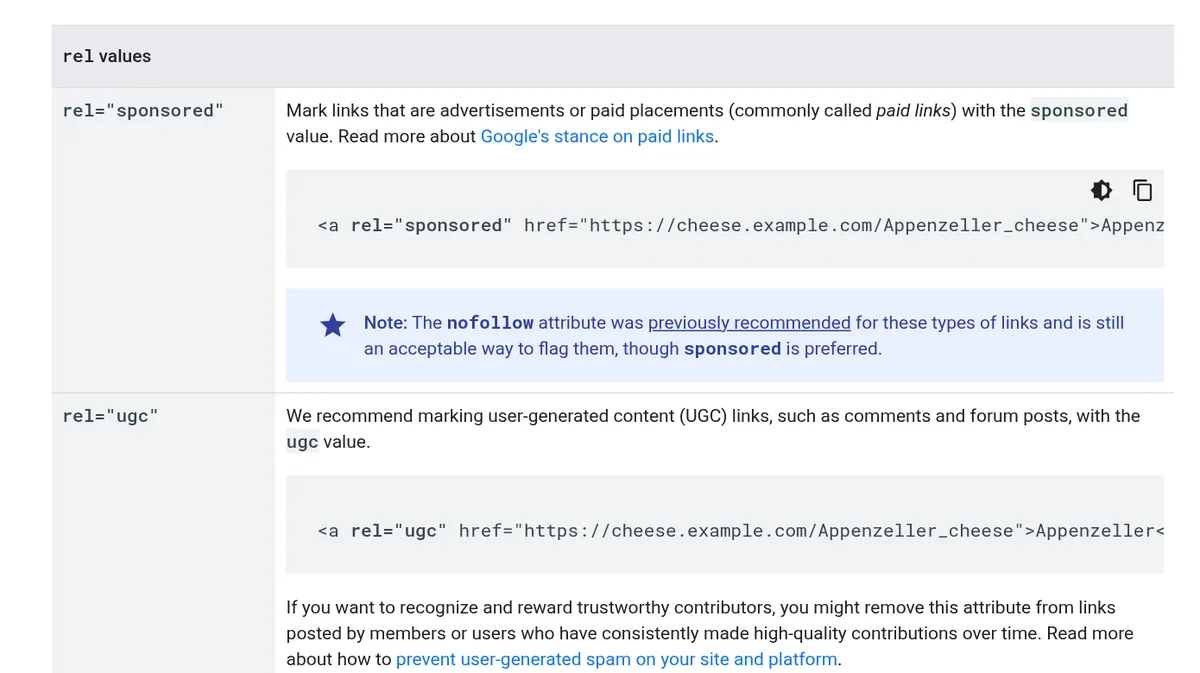
Google also has a rule for affiliate links on websites. Its Search Central docs say to mark links that are ads or paid placements with rel="sponsored." An affiliate link is a paid link, so I tag mine this way.
<a href='https://overskill.com/?ref=3jvtifuj' rel='sponsored'>Overskill</a>
Google's page says rel="nofollow" is still acceptable for these links, but "sponsored" is preferred. It also lists rel="ugc" for links in comments and forum posts.
Check your website builder's link settings for a rel option. If it has none, you can add it in the HTML.
Where to share affiliate links
You can start small. You need the right link in front of the right person. Places that work well for beginners:
- Blog posts that answer a question, like a how to guide or a review.
- YouTube videos, with the link in the description and a spoken disclosure.
- Your email list, when the tool solves a problem your readers have.
- Social posts, where the platform allows links.
Match the link to the moment. A link in a post that answers how do I build an app without code? makes sense. The same link dropped into a post about cooking does not. When the link solves the exact problem the reader came with, it feels like help, not a sales pitch.
No website? You can still do this. See affiliate marketing without a website.
My video: A step by step tutorial on ways to promote affiliate links for free. I recorded this in 2022, so some screens look different now.
Any results mentioned in videos are not typical and are not a promise of income. Your results depend on your work and your market.
How to tell if a link is an affiliate link
As a reader, you can often spot one. Hover over the link, or look at the address bar after you click. Signs to look for:
- A tag like ?ref=, ?via=, ?aff=, or ?tag= near the end.
- A short link that redirects to a store.
- A disclosure near the link, like "paid link" or "I get commissions."
An honest creator will tell you. If they do not, that tells you something too.
Common affiliate link mistakes
- No disclosure, or one hidden at the bottom of the page.
- Broken links. Test every link after you publish.
- Wrapped or shortened links that hide where the reader is going. Use the plain link the program gives you.
- Sharing links for things you have not tried. Only share what you have used.
- Breaking program rules, like bidding on brand names in ads when the terms say no.
Before you share an affiliate link
Nothing you check here is sent or saved. Download it if you want to keep it.
Meet AIM Agent
AIM Agent is an AI Chief of Staff for business owners. You give it a real task, and it brings the work back for you to review. You stay the one who approves.
Meet AIM AgentI am a co-founder of AIM Agent and have a financial interest in the product.
Frequently asked questions
What is an affiliate link?
It is a unique link a company gives you so it can track the visitors you send. If they buy, the company credits you, based on its program terms.
How do I get an affiliate link?
Join a company's affiliate program, get approved, and copy your link from the affiliate dashboard. Look for Affiliates or Partners in the site footer.
Do I have to disclose affiliate links?
In the US, yes. The FTC says to disclose clearly and conspicuously, and the closer the disclosure is to your recommendation, the better.
Is saying affiliate link enough?
The FTC says people might not understand the phrase affiliate link by itself. It says paid link right next to the link should be adequate.
Should affiliate links be nofollow?
Google says to mark them rel="sponsored". It says nofollow is still acceptable, but sponsored is preferred.
Does the buyer pay more through an affiliate link?
Usually not. The commission is paid by the company. Check each program's terms to be sure.
Sources
Checked October 25, 2026. Plans, prices, and rules can change.
