
Affiliate Marketing · Guide
Facebook can be a good place to share products you use. Here is how to do it in a way that helps people and follows Meta's labeling rules.
I have used Facebook to grow my business for years. Part of my community is there, so I get asked about affiliate marketing on Facebook.
The short answer: yes, you can do it. But there are rules about labels, and there is a right way to post. On October 24, 2026, I read Meta's help pages on paid partnership labels and the FTC's guide on endorsements. Here is what they say, in plain words.
Quick answer
Affiliate marketing on Facebook means sharing a product you use with your affiliate link and earning a commission if someone buys. Meta's Business Help Center says content with an affiliate link should have the Paid partnership label. The FTC also wants a clear disclosure close to your recommendation. Post helpful content first, label every affiliate post, and send people to a page you own.
What is affiliate marketing on Facebook?
Affiliate marketing means you recommend a product with a special link. If someone buys through that link, the company pays you a commission. You do not make the product or handle support.
On Facebook, you share that link in posts, reels, or groups. People see it, click, and maybe buy. If you are brand new, start with my guide on how affiliate marketing works.
Can you post affiliate links on Facebook?
Yes, and Meta's help pages explain how to label them. Here is the key line from the Business Help Center:
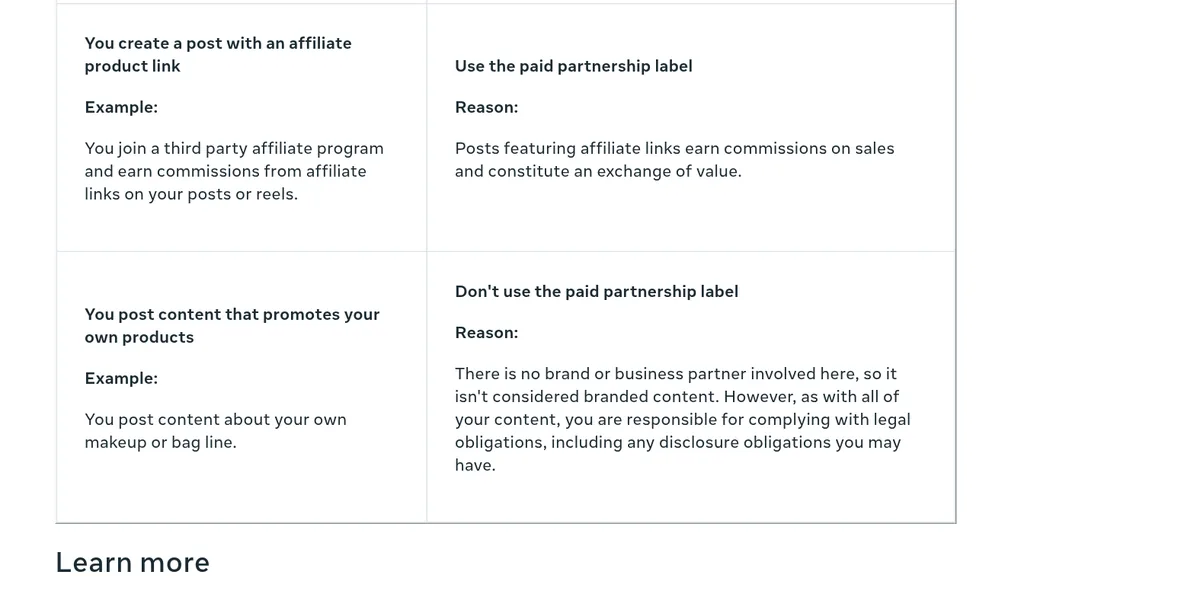
"Content that features an affiliate link should have the Paid partnership label, but does not need to have a business partner tagged."
Meta's page on branded content gives the reason. It lists this example: "You join a third party affiliate program and earn commissions from affiliate links on your posts or reels." The action it gives is to use the paid partnership label. The reason it gives: "Posts featuring affiliate links earn commissions on sales and constitute an exchange of value."
One exception. If you post about your own product, Meta says not to use the paid partnership label, because there is no brand partner. You still have to follow any legal disclosure rules.
What the FTC says about disclosure
Meta's label is one part. The FTC has its own guide for people who earn from endorsements in the US.
Here are the parts I would focus on for Facebook:
- Say it in plain words. The FTC gives this example: "I get commissions for purchases made through links in this post."
- Put it close. The FTC says "The closer the disclosure is to your recommendation, the better."
- Do not rely only on the platform tool. The FTC says a built-in tool is fine to use, but it will still look at whether the disclosure is clear on its own.
- Do not just write "affiliate link." The FTC says people might not understand what it means.
The FTC also says that "#ad," "Ad:," and "ad" at the beginning of a post are probably all equal. So a simple "Ad:" at the start works, plus a plain sentence near the link.
I am not a lawyer, and this is not legal advice. But my rule is easy: label it with Meta's tool and say it in your own words, every time.
A simple 5 step plan
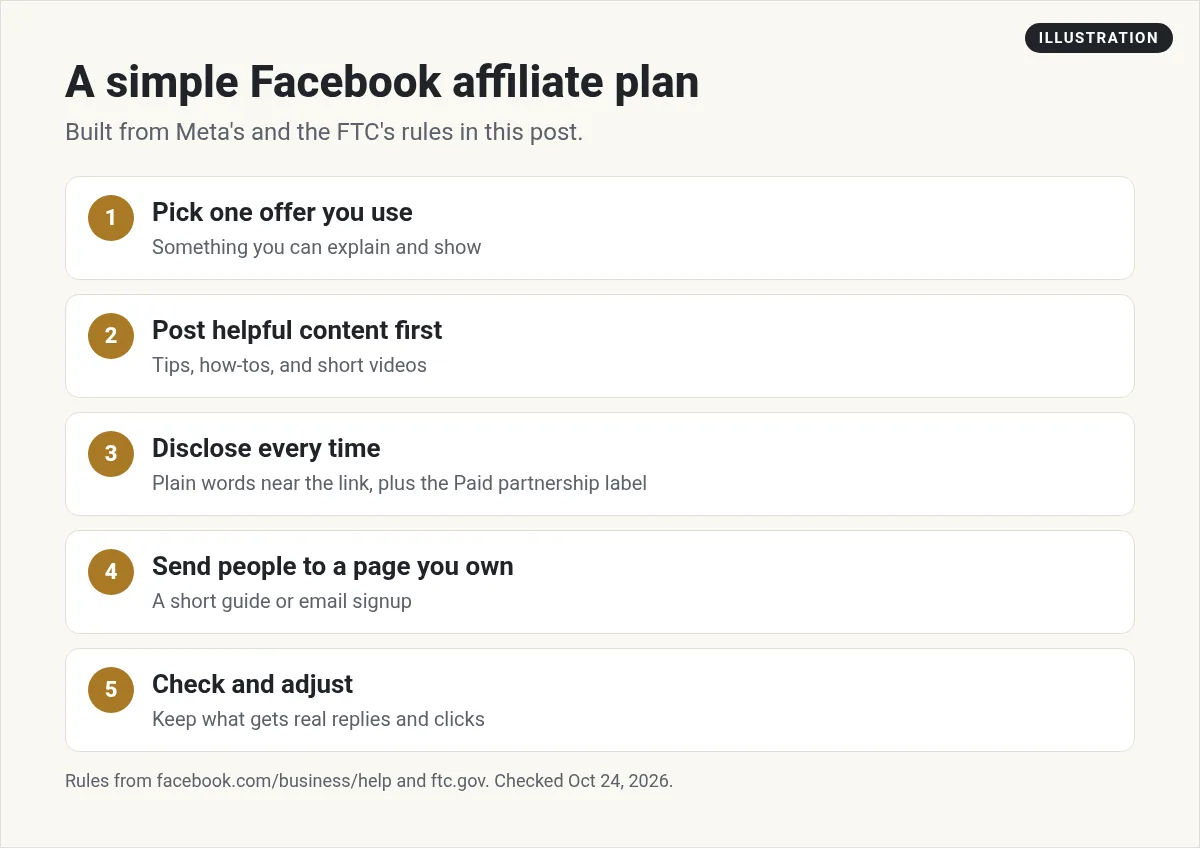
1. Pick one offer you use
Choose something you have used and would tell a friend about. It is easier to talk about, and people can tell when you mean it. My list of affiliate programs for beginners can help you pick.
Before you join a program, check these things:
- Do you use it? If not, try it first.
- Does it fit your people? Pick something your friends and followers would care about.
- Is the company clear about its terms? Read how and when commissions are paid.
- Does it allow social posts? Some programs have their own rules about where you can share links.
- Is there a refund policy? A fair policy protects your buyers and your name.
Some programs pay a commission each month for as long as the customer stays. I explain how those programs work in my video on recurring programs below.
2. Post helpful content first
Do not lead with the link. Lead with help. Show how you use the product. Share a tip, a mistake, or a before and after. Plenty of your posts can have no link at all.
3. Disclose every time
Turn on the Paid partnership label when your post has an affiliate link. Then add a plain sentence near the link that says you earn a commission.
4. Send people to a page you own
Facebook can change its reach any time. So when you can, send people to a simple page or free guide where they join your email list. Then you can reach them again. A lead magnet works well for this.
5. Check and adjust
Look at which posts get comments and clicks. Do more of what works. Drop what does not.
Where to post on Facebook
- Your profile. Good for sharing your real story with friends and followers.
- A Facebook Page. Good if you want a brand that is separate from your personal life.
- Reels. Short videos that show how you use something.
- Groups. Groups can be great for helping people. But each group has its own rules. Some do not allow links at all. Read the rules first.
What to post: easy ideas
- A quick video of how you use the tool, start to finish.
- Three mistakes you made when you started, and how to avoid them.
- A side by side of two tools you tried.
- An answer to a question someone asked you.
- A screenshot of a result, with what it means and what it does not mean.
If you make YouTube videos, you can turn them into Facebook posts. I show how in turning a YouTube transcript into Facebook posts. Also on Instagram? See my guide to Instagram affiliate marketing.
A simple post you can copy
Here is a format I like. It is short, helpful, and clear about the link.
Ad: I have used [tool] for [time] to [job]. Here are 3 things I wish I knew on day one.
1. [tip]
2. [tip]
3. [tip]If you want to try it, here is my link. I get a commission if you buy through it. [link]
Then turn on the Paid partnership label before you post.
Notice what this does. It leads with help. It tells the truth about the link. And it lets people decide. Swap in your own words so it sounds like you.
How long does it take to see results?
I cannot give you a number, and I would not trust anyone who does. It depends on your offer, your posts, and how often you show up.
What I can tell you is what to watch in your first month:
- Are people commenting or asking questions?
- Which posts get saved or shared?
- Are people clicking through to your page?
Those signals tell you what to make more of. Sales, if they come, follow trust. If you want ideas for finding people without paying for ads, see free traffic sources.
Getting started with affiliate marketing
My video: How I would start affiliate marketing in 2026, from zero.
Any results mentioned in videos are not typical and are not a promise of income. Your results depend on your work and your market.
My video: Why I like affiliate programs that pay every month.
Any results mentioned in videos are not typical and are not a promise of income. Your results depend on your work and your market.
Mistakes to avoid
- Posting links with no label. Meta says affiliate content should have the Paid partnership label.
- Spamming groups. Dropping links in groups can get you removed. Help first.
- Making big promises. Do not tell people what they will earn or how fast. Talk about what the product does.
- Only selling. If every post has a link, people stop reading.
- Not owning your list. Your Facebook reach can change. An email list stays with you.
Want to try this without a big following? Read affiliate marketing with no followers.
Facebook affiliate post checklist
Nothing you check here is sent or saved. Download it if you want to keep it.
Learn how I use AI to create content faster
Want help making helpful posts without spending all day? Join my free AI workshop. I show the tools and steps I use.
Join my free AI workshopFree to join. No credit card needed.
Frequently asked questions
Is affiliate marketing allowed on Facebook?
Meta's Business Help Center explains how to label it. It says content with an affiliate link should have the Paid partnership label.
Do I need to tag the brand in an affiliate post?
Meta says affiliate content should have the Paid partnership label but does not need a business partner tagged.
Is the Facebook label enough for the FTC?
The FTC says platform tools are fine to use, but it will look at whether the disclosure is clear. Add a plain sentence near your link too.
What should I write to disclose?
The FTC gives this example: I get commissions for purchases made through links in this post. Put it close to your recommendation.
Can I post affiliate links in Facebook groups?
It depends on the group. Each group has its own rules, and some do not allow links. Read the rules first.
Do I need a lot of followers?
No. Start by helping a small group of people with honest posts. Send them to a page you own so you can follow up.
Sources
Checked October 24, 2026. Plans, prices, and rules can change.
