
AI Tools · Pricing
The Claude API is pay as you go. You pay per million tokens in and out, and the price depends on the model. Here is every current price, a real cost example, and the ways to pay less.
If you build an app, a chatbot, or an automation on Claude, you pay through the API. That is different from a Claude Pro or Max plan. There is no flat monthly fee. You pay for each token you send and get back.
I checked Anthropic's API pricing docs on October 26, 2026. Here is what each model costs, what a real job might cost, and the built-in ways to cut your bill.
Quick answer
The Claude API charges per million tokens (MTok), pay as you go. On October 26, 2026, Anthropic's docs listed Claude Fable 5.1 at $10 per million input tokens and $50 per million output tokens. Claude Opus 5.5 was $4 input and $20 output per million. Claude Sonnet 5.5 was $2 input and $10 output per million. Claude Haiku 5.5 was $0.10 input and $0.50 output per million for prompts up to 100,000 tokens. The Batch API cuts input and output prices by 50%.
How Claude API pricing works
A token is a small piece of text. Anthropic's docs say: "Tokens are pieces of text that models process." Your prompt is input tokens. Claude's reply is output tokens.
Prices are listed per MTok, which means per one million tokens. On every model listed in this post, output costs five times as much as input.
One detail matters for newer models. The docs say Claude 4.7 and later models use a newer tokenizer that "produces approximately 30% more tokens for the same text." So the same prompt can count as more tokens on a newer model than on an older one.
If you only chat with Claude and do not build apps, the API is not for you. See my guide to Claude Pro vs Max for the monthly plans.
Claude API prices by model
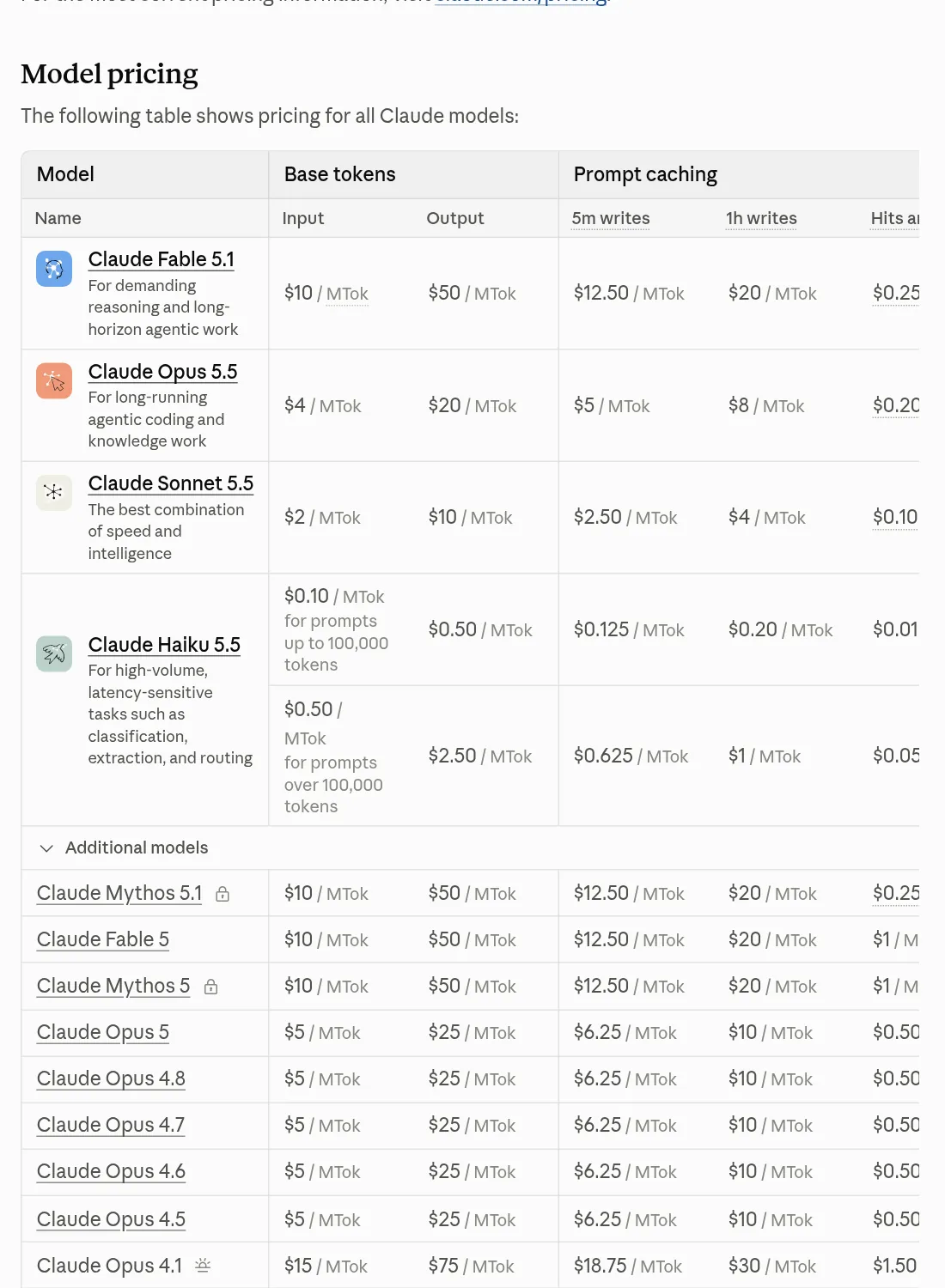
Here are the main current models from Anthropic's pricing table on October 26, 2026. All prices are pay as you go, in US dollars, per million tokens.
Claude Fable 5.1
$10 per million input tokens and $50 per million output tokens. Anthropic describes it as "For demanding reasoning and long-horizon agentic work."
Claude Opus 5.5
$4 per million input tokens and $20 per million output tokens. The docs say it is "For long-running agentic coding and knowledge work."
Claude Sonnet 5.5
$2 per million input tokens and $10 per million output tokens. Anthropic calls it "The best combination of speed and intelligence."
Claude Haiku 5.5
Haiku 5.5 is priced by prompt length. For prompts up to 100,000 tokens, it is $0.10 per million input tokens and $0.50 per million output tokens. For prompts over 100,000 tokens, it is $0.50 per million input and $2.50 per million output. Anthropic says it is "For high-volume, latency-sensitive tasks such as classification, extraction, and routing."
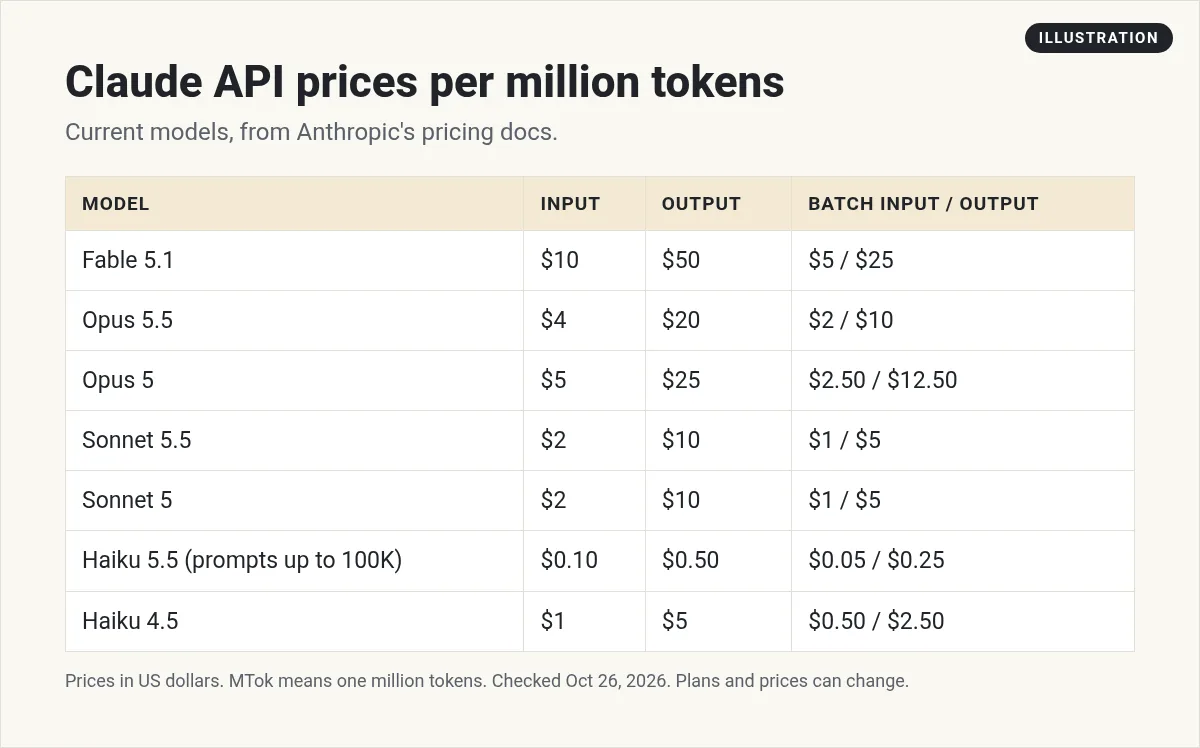
Older models still listed
The docs also list older models under "Additional models." A few examples, all per million tokens, pay as you go:
- Claude Opus 5: $5 input, $25 output
- Claude Sonnet 5: $2 input, $10 output
- Claude Sonnet 4.6 and 4.5: $3 input, $15 output
- Claude Haiku 4.5: $1 input, $5 output
Note that some newer models cost less than older ones. Opus 5.5 at $4 input is cheaper than Opus 5 at $5 input. Check the table before you assume a newer model costs more.
What a real job costs
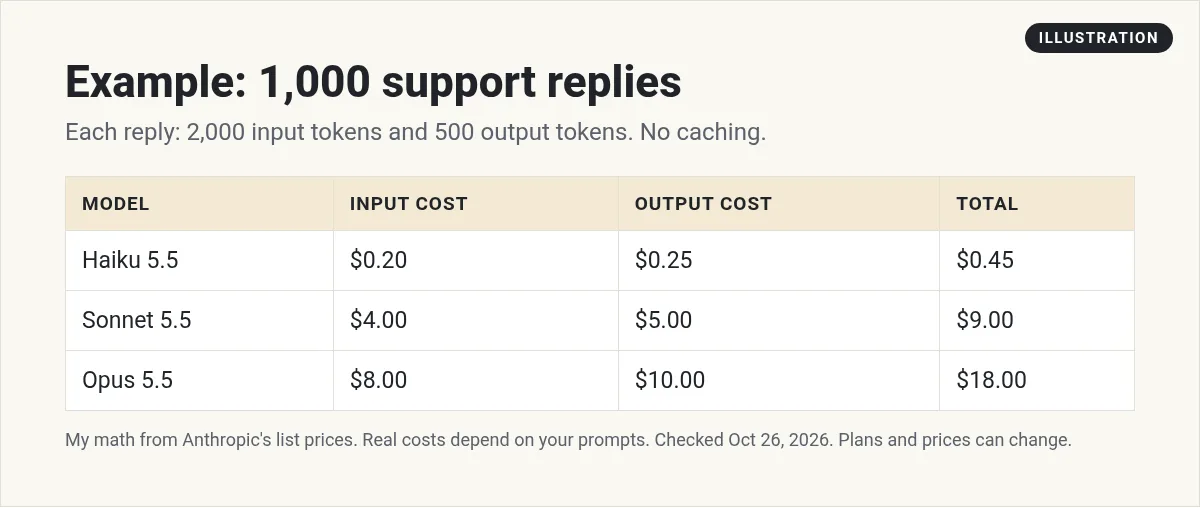
Here is an example, using my math from Anthropic's list prices. Say you send 1,000 support replies. Each one uses 2,000 input tokens and 500 output tokens. No caching. That is 2 million input tokens and 500,000 output tokens in total.
- Haiku 5.5: $0.20 input plus $0.25 output, about $0.45 total
- Sonnet 5.5: $4.00 input plus $5.00 output, about $9.00 total
- Opus 5.5: $8.00 input plus $10.00 output, about $18.00 total
Your real cost depends on how long your prompts and replies are. Model choice makes a big difference, so test the smaller model first.
How to pay less
1. Batch API: 50% off
The docs say: "The Batch API allows asynchronous processing of large volumes of requests with a 50 percent discount on both input and output tokens." Batch prices per million tokens include Opus 5.5 at $2 input and $10 output, Sonnet 5.5 at $1 input and $5 output, and Haiku 5.5 at $0.05 input and $0.25 output (prompts up to 100,000 tokens). Use it for work that does not need an instant reply, like overnight reports.
2. Prompt caching
If you send the same long instructions or documents again and again, caching helps. A 5 minute cache write costs "1.25x base input price." A cache read costs "0.1x base input price." The docs add lower read rates for some models: 0.025x on Claude Fable 5.1 and 0.05x on Claude Opus 5.5 and Claude Sonnet 5.5.
The docs say "caching pays off after one cache read" for the 5 minute cache. They also say these multipliers "stack with other pricing modifiers, including the Batch API discount."
3. Pick the right model
Use Haiku for sorting, tagging, and pulling out data. Use Sonnet for most writing and coding. Save Opus and Fable for the hardest jobs.
Extra costs to plan for
- Web search. The docs say it is "$10 USD per 1,000 searches, plus standard token costs for search-generated content."
- US-only inference. For Claude 4.6 and later, choosing US-only processing "applies a 1.1x pricing multiplier."
- Fast mode. Opus 5.5 fast mode is $8 per million input tokens and $40 per million output tokens. The docs say fast mode "is not available with the Batch API."
- Managed Agents. Session runtime is "$0.08 USD per session-hour," on top of tokens. The docs give an example: a 1 hour Opus 5.5 session with 50,000 input and 15,000 output tokens costs $0.58.
Long prompts are not extra on most new models. The docs say Claude 4.6 and later models, except Haiku 5.5, "include the full 1M token context window at standard pricing."
How to estimate your monthly bill
You can get a rough number before you write any code:
- Count your jobs. How many requests will your app send in a month? For example, 30 replies a day is about 900 a month.
- Measure one job. Send one real request and look at the input and output token counts the API sends back with the reply.
- Multiply. Tokens per job times jobs per month gives your monthly tokens, split into input and output.
- Apply the price. Divide by one million and multiply by the model's price per million tokens.
- Add a buffer. Retries, longer chats, and tool calls add tokens. Add some room on top.
Then watch your usage closely, so a bug or a traffic spike does not turn into a surprise bill. Check your usage each week for the first month, and switch to a smaller model where the results are good enough.
API vs a Claude plan
The API is for building. A Claude plan is for using Claude yourself. If you use Claude Code to write software, a Pro or Max plan may cost less than paying API rates for heavy daily use. My Claude Code pricing guide compares the two.
If you want to compare other providers, see my guide to ChatGPT pricing. New to Claude? This is my full beginner tutorial.
My video: My full Claude walkthrough for beginners. Plans and prices have changed since I recorded it, so use this post for current API prices.
Any results mentioned in videos are not typical and are not a promise of income. Your results depend on your work and your market.
Before you build on the Claude API
Nothing you check here is sent or saved. Download it if you want to keep it.
Meet AIM Agent
AIM Agent is an AI Chief of Staff for business owners. You give it a real task, and it brings the work back for you to review. You stay the one who approves.
Meet AIM AgentI am a co-founder of AIM Agent and have a financial interest in the product.
Frequently asked questions
How much does the Claude API cost?
It is pay as you go, per million tokens. On October 26, 2026, Opus 5.5 was $4 input and $20 output per million tokens, Sonnet 5.5 was $2 and $10, and Haiku 5.5 was $0.10 and $0.50 for prompts up to 100,000 tokens.
What is the cheapest Claude API model?
Among current models, Claude Haiku 5.5 at $0.10 per million input tokens and $0.50 per million output tokens, for prompts up to 100,000 tokens.
How much is Claude Opus on the API?
Claude Opus 5.5 is $4 per million input tokens and $20 per million output tokens. Older Opus 5 is $5 input and $25 output per million.
Does the Claude API have a discount?
Yes. The Batch API gives a 50 percent discount on input and output tokens. Prompt caching also cuts the cost of repeated input.
Is the Claude API included in Claude Pro?
No. API use is billed separately, pay as you go. Claude's pricing page lists API credits as a Max plan perk.
What is an MTok?
MTok means one million tokens. Claude API prices are listed per MTok, for input and output.
Sources
Checked October 26, 2026. Plans, prices, and rules can change.
