
GoHighLevel · API
The GoHighLevel API lets other apps read and update your HighLevel data. Here is how access works now, what it costs, the limits, and how to make your first call safely.
Sooner or later, you will want HighLevel to talk to another tool. Maybe your website, a custom app, or an AI assistant. That is what the API is for.
The rules changed a lot in the last year. Old API keys are on the way out. I read HighLevel's help center, API docs, and changelog on October 20, 2026. Here is what you need to know, in plain English.
Quick answer
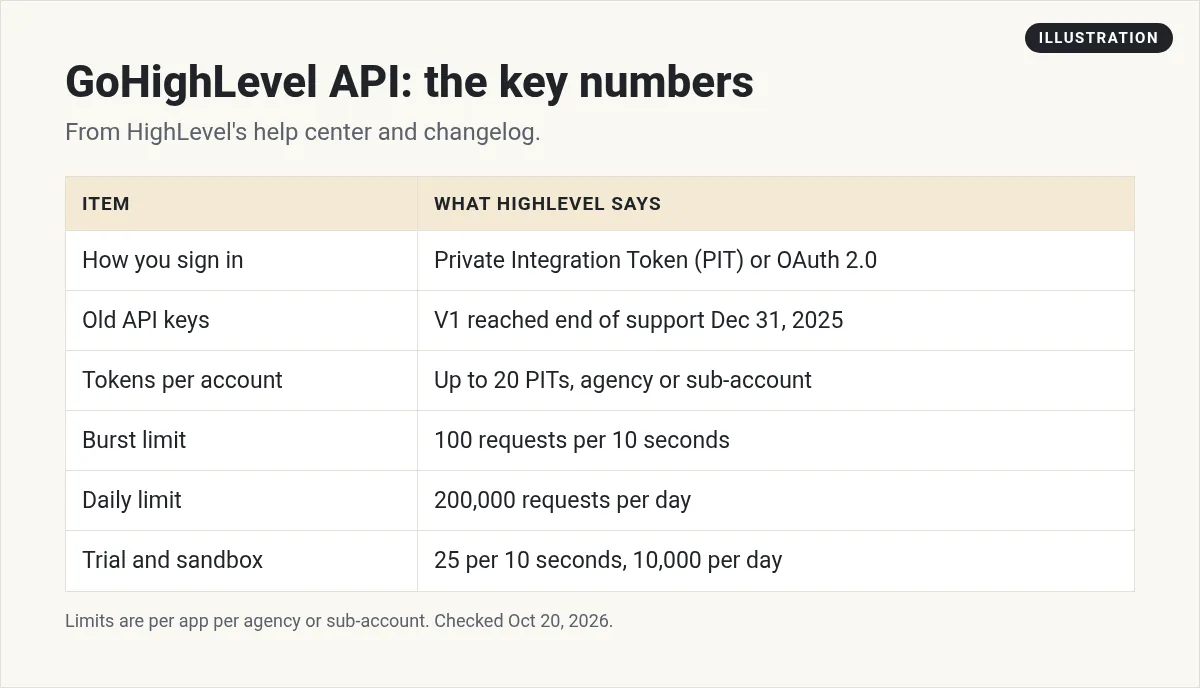
The GoHighLevel API lets other apps read and change data in your HighLevel account, like contacts, opportunities, and calendars. Today you connect with a Private Integration Token (PIT) that you create in settings, or with OAuth 2.0 for Marketplace apps. Old V1 API keys reached end of support on December 31, 2025. The limits are 100 requests per 10 seconds and 200,000 a day per app, per agency or sub-account. Trial and sandbox accounts get lower limits. HighLevel's help center says Basic API access comes with Starter and Unlimited, and Advanced access with Agency Pro.
What the GoHighLevel API does
HighLevel's help center says its API includes "REST endpoints for contacts, messaging, workflows, calendars, payments, webhooks, and more." New to contacts and pipelines? Start with my GoHighLevel CRM guide.
In plain words, an API is a door for other software. Your app knocks on the door, shows a key, and asks HighLevel to do something. For example: add this new lead, or move this deal to the next stage.
Private Integration Tokens replaced API keys
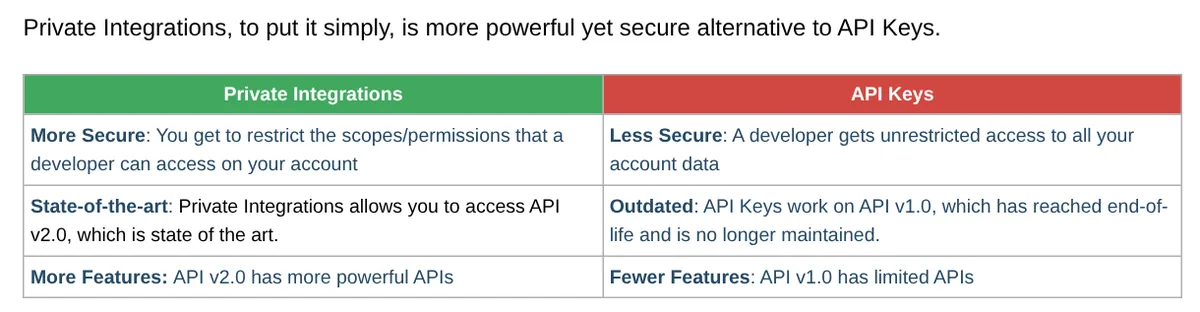
This is the biggest change. HighLevel's help center says V1 APIs "reached end-of-support as on 31-December-2025." Old connections still run, but get no support or updates. HighLevel is also removing the option to make new API keys.
The new way is a Private Integration Token, or PIT. HighLevel calls Private Integrations a "more powerful yet secure alternative to API Keys." Here is why that matters:
- You choose what it can touch. When you make a PIT, you pick its scopes. An old API key gave full access to everything.
- It uses the newer API. PITs work with API v2.0 and up. HighLevel says API v3 is now out for supported endpoints too.
- You can have several. HighLevel says you can create up to 20 PITs at both the agency and sub-account level. Use one per tool, so you can turn one off without breaking the others.
Which plans include API access?
This is one place where HighLevel's pages do not say quite the same thing, so here are both, checked October 20, 2026:
- The help center says "Basic API access is included with our Starter and Unlimited plans, while Advanced API access is available on our Agency Pro plan."
- The pricing page lists API Access as a core feature. On the plan cards, it shows Basic API Access under Unlimited ($297 a month) and Advanced API Access under Agency Pro ($497 a month).
The help center adds that Advanced access unlocks Agency API keys and the agency-level OAuth API. If you are on Starter and need API access for a big project, ask HighLevel support to confirm before you build.
How to make your first API call
Here are the steps from HighLevel's help center. Do this in a test sub-account first.
- Open Private Integrations in your settings. HighLevel says if you do not see it, turn the feature on in Labs.
- Click Create new Integration. Give it a clear name, like the tool it is for.
- Pick only the scopes you need. If a tool only adds contacts, give it contact access only.
- Copy the token right away. HighLevel warns you will not be able to see it again.
- Make a test call. HighLevel's docs show calls to services.leadconnectorhq.com with your token and a Version header.
Here is the shape of a test call, based on HighLevel's API docs. Swap in your own token and sub-account ID.
curl --request GET \
  --url https://services.leadconnectorhq.com/locations/YOUR_LOCATION_ID \
  --header 'Accept: application/json' \
  --header 'Authorization: Bearer YOUR_TOKEN' \
  --header 'Version: 2021-07-28'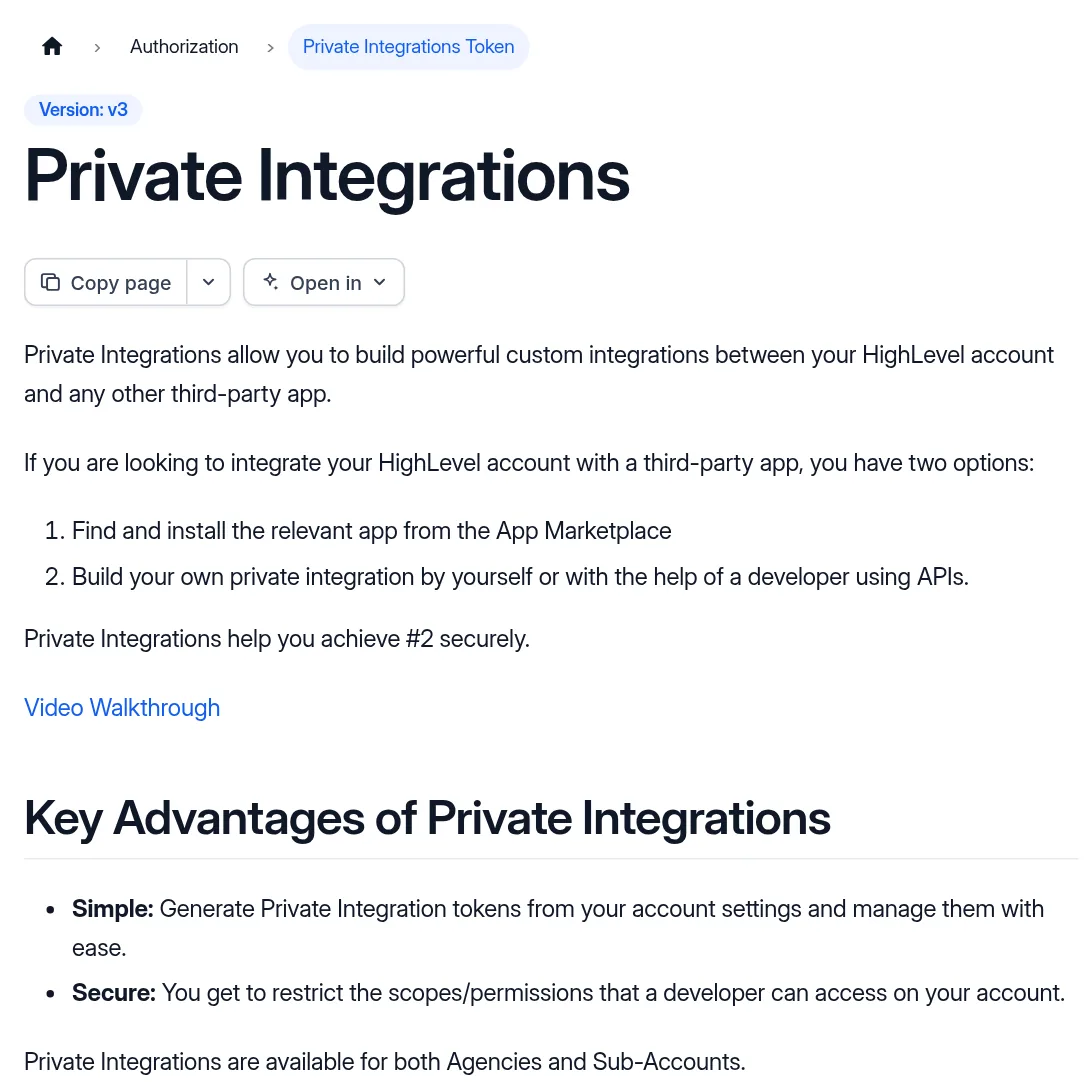
PIT or OAuth: which one do you need?
HighLevel offers two ways to sign in to the API. Here is the simple rule.
| Private Integration Token | OAuth 2.0 | |
|---|---|---|
| Best for | Your own account and your own tools | Apps you list on the HighLevel Marketplace for others |
| How you get it | Made in settings with a few clicks | Made by code, by trading an access code for tokens |
| Does it expire? | No, it stays the same until you rotate it | Access tokens expire daily and need a refresh |
Based on HighLevel's help center, checked October 20, 2026.
HighLevel puts it simply: Private Integrations are static, fixed OAuth2 access tokens. If you are connecting your own business to your own tools, a PIT is almost always the right pick.
Common ways people use the API
- Send leads from a custom website into HighLevel as new contacts.
- Move deals to a new pipeline stage when something happens in another app.
- Pull data out for a custom report or dashboard.
- Connect an app you built with an AI app builder to your CRM.
Rate limits: how much you can call
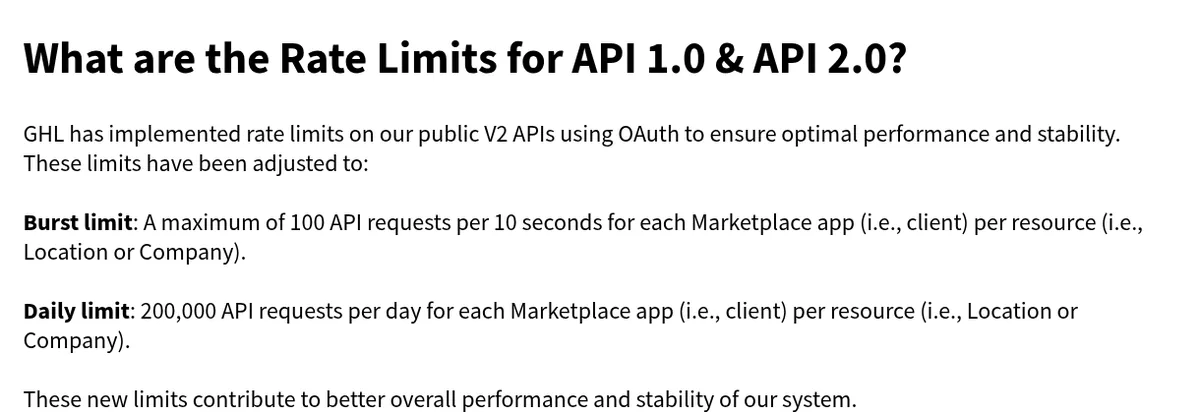
HighLevel's help center lists two limits for its V2 APIs, for each Marketplace app per agency or sub-account:
- Burst limit: 100 requests every 10 seconds
- Daily limit: 200,000 requests a day
Trial and sandbox accounts get lower limits. HighLevel's changelog says PITs now work on those accounts with a burst limit of 25 requests per 10 seconds and a daily limit of 10,000. Those limits are shared by all the tokens in the account.
Your app can watch its usage. HighLevel says each response includes headers like X-RateLimit-Remaining and X-RateLimit-Daily-Remaining. If you get close to the limit, slow down.
Keep your tokens safe
HighLevel recommends rotating your Private Integration tokens every 90 days. When you rotate, the old and new tokens both work for 7 days. That gives you time to update your other app. If a token leaks, use the option to rotate and expire it now.
Also, HighLevel says legacy API keys that sit unused for more than 90 days may be marked as expired. Move old connections to PITs now, before they break.
Do you even need the API?
Often, no. HighLevel's help center points out two options. You can install an app from the HighLevel App Marketplace, or build your own private integration with the API. If a Marketplace app or a tool like Zapier already does the job, start there.
There is also a new third option for AI. HighLevel's docs describe a LeadConnector MCP server. It lets AI assistants like Claude and ChatGPT work with your CRM through OAuth, with "more than 550 active read, create, update, and delete operations across 38 domains." You sign in and approve access instead of making a token. I show how to connect Claude in my GoHighLevel and Claude guide.
And if you just want HighLevel to do more on its own, read GoHighLevel automation first. Workflows can handle a lot without any code.
My GoHighLevel API checklist
Nothing you check here is sent or saved. Download it if you want to keep it.
Want to try the API on a test account?
Start a HighLevel trial and practice with a test sub-account first. Through my link, new customers get a 30-day trial instead of the standard 14 days, checked October 20, 2026.
Start my 30-day GoHighLevel trialI earn a commission if you buy through this link. Billing starts when the trial ends unless you cancel. Trial accounts have lower API limits. Usage fees for phone, email, and AI can apply during the trial.
Want an AI team to help run your business? Meet AIM Agent, an AI Chief of Staff for business owners. I am a co-founder of AIM Agent and have a financial interest in the product.
Frequently asked questions
Does GoHighLevel have an API?
Yes. HighLevel has REST APIs for contacts, messaging, workflows, calendars, payments, webhooks, and more. The docs are at marketplace.gohighlevel.com/docs.
How do I get a GoHighLevel API key?
New API keys are being phased out. Create a Private Integration Token in your settings instead, and pick only the scopes you need. V1 APIs reached end of support on December 31, 2025.
Which GoHighLevel plan includes API access?
HighLevel's help center says Basic API access comes with Starter and Unlimited, and Advanced with Agency Pro. The pricing page shows Basic API Access on the Unlimited card and Advanced on Agency Pro. Checked October 20, 2026.
What are the GoHighLevel API rate limits?
100 requests per 10 seconds and 200,000 requests per day, for each app per agency or sub-account. Trial and sandbox accounts get 25 per 10 seconds and 10,000 per day.
How many Private Integration Tokens can I create?
HighLevel says up to 20 at both the agency and sub-account level.
Can I connect GoHighLevel to Zapier?
Yes. Zapier is one of the integrations shown on HighLevel's pricing page. A no-code tool like Zapier is often easier than writing API code.
Sources
Checked October 20, 2026. Plans, prices, and rules can change.
- HighLevel help: HighLevel API Documentation
- HighLevel help: Private Integrations, everything you need to know
- HighLevel API docs: Private Integrations
- HighLevel API docs: LeadConnector MCP Server
- HighLevel changelog: PITs now available for Sandbox and Trial accounts
- HighLevel pricing
- My HighLevel trial page (affiliate): gohighlevel.com/montoya
