
Grok Bot · Comparison
There are now five big names in personal AI agents. Two are open source, three are hosted for you. Here is how Grok Bot stacks up against each one, and how to pick.
Grok Bot vs Muse is the newest matchup in AI agents, but it is not the only one. In a few months we went from almost no personal agents to five big ones: Grok Bot, Meta's Muse, OpenAI's dots, and two open source projects, OpenClaw and Hermes Agent.
I read each official page on October 28, 2026, and watched the newest head to head tests. I run my business on Grok Bot, so I will tell you where I lean. But each of these has a real reason to exist, and I will be fair about that.
TL;DR
Grok Bot is a hosted team of Bots for work, each with its own job, on a shared cloud computer you can watch. Meta's Muse is a personal agent on its own secure cloud computer that you message in the Muse app or WhatsApp, rolling out in the US. ChatGPT dots is an always on agent inside ChatGPT, rolling out to eligible plans. OpenClaw and Hermes Agent are free, open source, MIT licensed agents you run yourself with your own model, and Hermes also offers a hosted option through Nous Portal. Pick Grok Bot for business work with many Bots, Muse for personal life, dots if you live in ChatGPT, and OpenClaw or Hermes if you want full control and like to tinker.
The quick map
The easiest way to sort these five is by two questions. Who runs the computer, and who is it for?
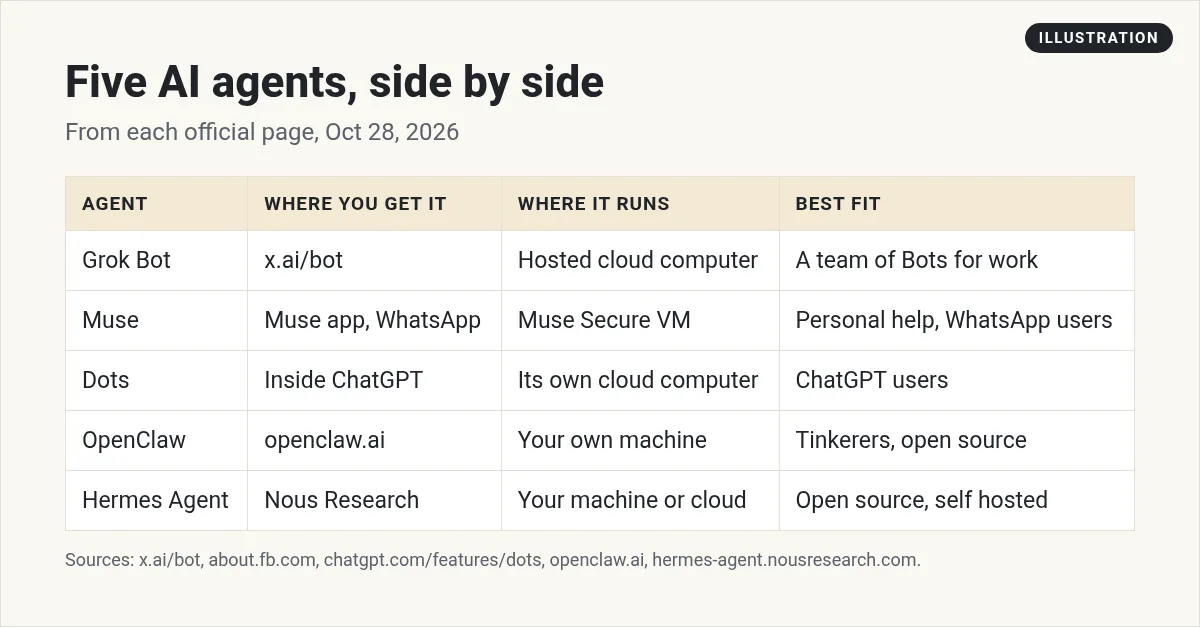
| Agent | Who runs it | Where you talk to it | Best fit |
|---|---|---|---|
| Grok Bot | Hosted for you | Desktop, phone, Slack | A team of Bots for business work |
| Muse | Hosted by Meta | Muse app, WhatsApp, muse.ai | Personal life and everyday tasks |
| ChatGPT dots | Hosted by OpenAI | ChatGPT, Slack, Teams | People who already live in ChatGPT |
| OpenClaw | You, on your own machine | WhatsApp, Telegram, Discord, Slack, Signal, iMessage and more | Tinkerers who want open source |
| Hermes Agent | You, on your machine or a server, or hosted through Nous Portal | Telegram, Discord, Slack, WhatsApp, Signal, email, terminal | Builders who want open source with memory |
I left prices out on purpose. They change fast, so check each official page before you choose.
Grok Bot: a team for work
Grok Bot lets you make many Bots, each with its own job, memory, skills, and routines. They share one cloud computer with a browser, and you can watch it and take over for a login. Bots can work together in group chats. Safety comes from Auto Review, approval cards, Ask first rules, and Vault for logins. My Grok Bot explained post covers it all.
Where it shines: real business work split across many jobs. Where it is weaker: a fresh Bot does not know you yet, and some sites block bots.
Meta Muse: a personal agent for everyone
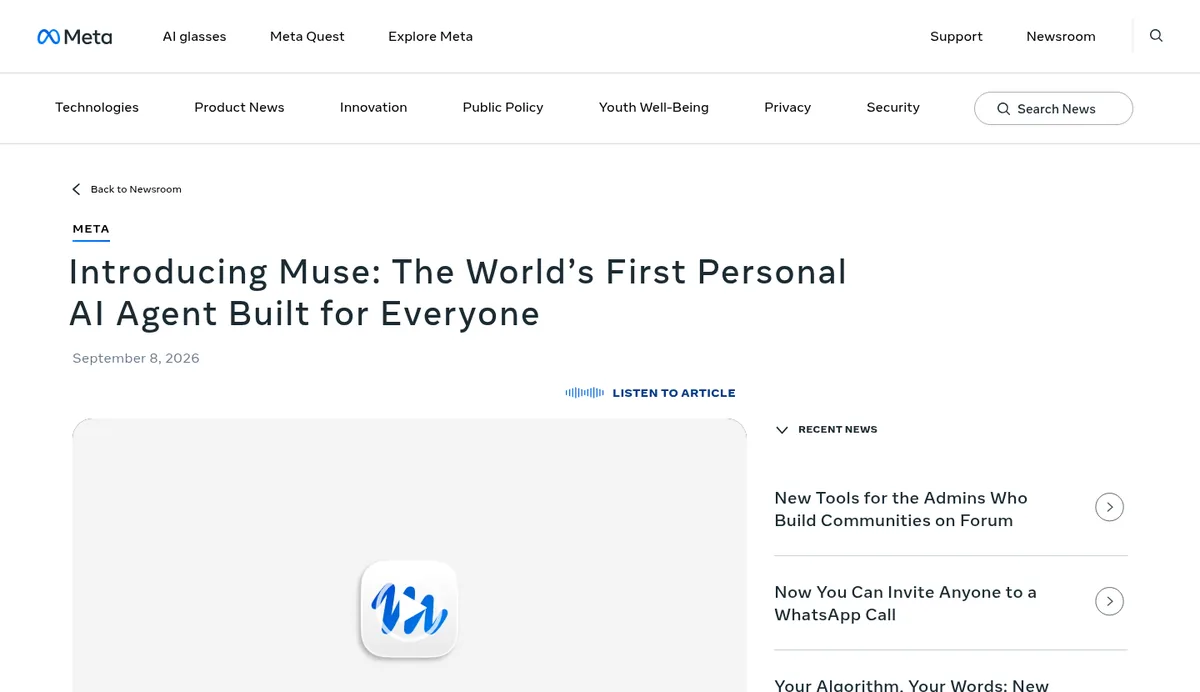
Meta introduced Muse on September 8, 2026. From Meta's own post:
- Muse runs on Muse Secure VM, "a dedicated secure computer with its own browser."
- You talk to it "in the Muse app or directly in WhatsApp," like messaging a person.
- It keeps working after you close the app and comes back when it needs approval, like before sending an email or making a purchase.
- A separate Sentinel agent runs on the same machine. Meta says "Nothing Muse does reaches the internet unless the Sentinel approves it."
- Muse cannot see your passwords or payment methods, and it shows a full audit trail of what it did and plans to do.
- You can tell it to forget specific things it learned.
- It is rolling out in the US on iOS, Android, and muse.ai.
Where it shines: personal life. Pat Simmons said it best after his test: "don't sleep on Muse for your personal life." He suggested it for things like restaurant ideas, travel, and research before a purchase. Where it is weaker: it is one agent. Pat found that talking to a single Muse "gets a little confusing" with side chats, and Amazon blocked it in Christian Peverelli's test.
ChatGPT dots: an agent inside ChatGPT
OpenAI introduced dots on September 29, 2026. It is an always on agent with its own cloud computer, inside ChatGPT, Slack, and Teams. It starts from your ChatGPT memory and connects to over 4,000 apps through plugins. It is rolling out to Pro users outside the EEA, Switzerland, and the UK, and to Business Premium users in supported regions.
Where it shines: careful answers and a head start on context. In Christian's test, dots read the actual menus to answer, and it refused to give an unverified top 3. Where it is weaker: for now you start with one dot, and to delete its own saved memories you have to delete the dot. I go deeper in Grok Bot vs ChatGPT.
OpenClaw: open source, on your machine
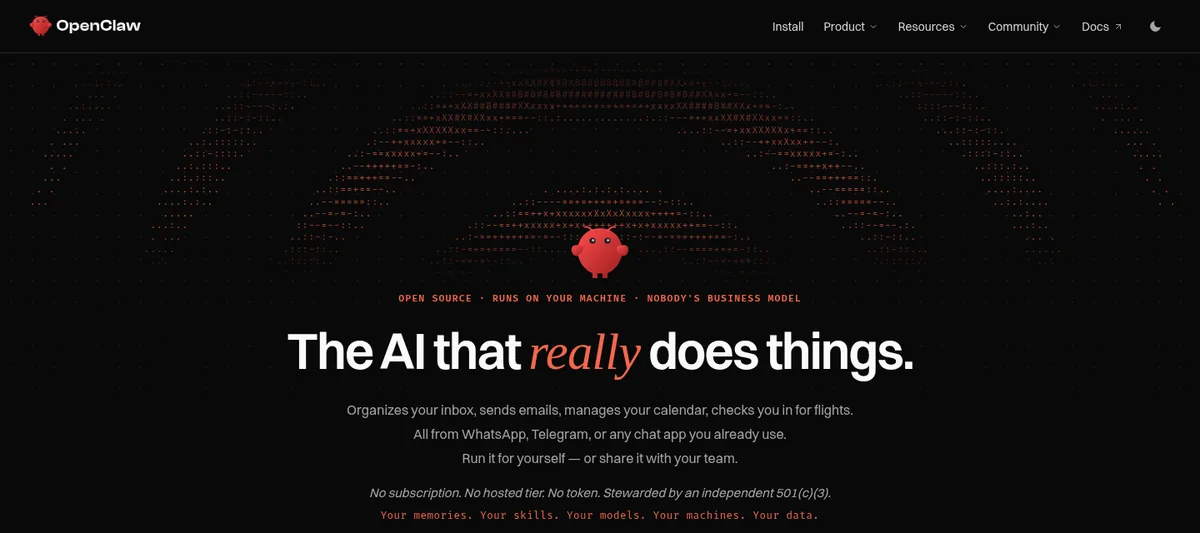
OpenClaw is an open source agent under the MIT license, run by the OpenClaw Foundation, a nonprofit. From its site and docs:
- It runs on your own computer, Mac, Windows, or Linux, and keeps its state locally.
- You bring your own model.
- You chat with it in apps you already use, like WhatsApp, Telegram, Discord, Slack, Signal, and iMessage.
- You can give it full system access or run it in a sandbox. It supports skills and plugins.
- There is no hosted version. OpenAI is a donor, but OpenClaw is not an OpenAI product.
Where it shines: control and privacy for people who like to set things up. Where it is weaker: you are the IT department. You pick the model, set up the machine, and own the security. Full system access on your own laptop is a real risk if you are not careful.
Hermes Agent: open source with memory
Hermes Agent comes from Nous Research. It is also open source under the MIT license. From its site:
- It has a desktop app and a terminal install.
- It works in Telegram, Discord, Slack, WhatsApp, Signal, email, and the terminal.
- It has persistent memory, makes its own skills as it learns, and takes schedules in plain language.
- It can run subagents and has several sandbox options.
- You bring your own model provider, and there is a path to move over from OpenClaw.
Where it shines: open source builders who want memory and self made skills. Where it is weaker: same as OpenClaw. You run it, you secure it.
Tech With Tim, who was tough on Grok Bot in his review, said he did not see it as much better than something like Hermes Agent for his own use. That is a fair view from a developer. For a business owner who does not want to run a server, a hosted tool is a different deal.
What the side by side tests found
From the Pat Simmons channel (not mine): Pat Simmons gives Grok Bot, dots, and Muse the same jobs, from planning a trip to running a fake online coffee company's day to day work, and ranks them.
- Pat Simmons picked Grok Bot for work: "I don't even think it's close." He liked having "a team of bots, each with its own job." He picked Muse for personal tasks, and said dots still has a long way to go.
- Christian Peverelli said he is "completely torn between GrokBot and Muse." He called Grok Bot "a little bit more business-oriented" and Muse "so easy to use."
- Ray Fernando ran a long live test of Grok Bot against OpenClaw and Hermes on real business automation, and came away excited about how fast you can get going with connectors.
How to pick in 4 questions
- Is this for work or for life? Work with many jobs, lean Grok Bot. Personal errands, look at Muse.
- Do you want to run your own machine? If yes, and you like tinkering, try OpenClaw or Hermes. If no, pick a hosted one.
- Where does your context live? Years of ChatGPT memory points to dots.
- Do you need it in your region today? Muse is rolling out in the US. Dots for Pro users is not in the EEA, Switzerland, or the UK. Check each page.
Many people will use two. I use Grok Bot for my business and keep an eye on the rest. Whatever you pick, read Grok Bot safety first. The same habits apply to every agent.
Why a business team beats one assistant
The testers agree on one thing. Grok Bot wins on business work because you can have a team of Bots with their own jobs. The catch is you have to design that team yourself.
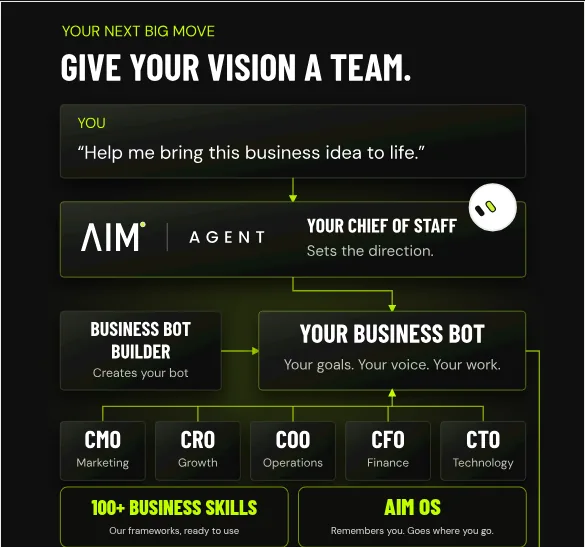
AIM Agent is an AI Chief of Staff for business owners. It comes with an AI C-suite (COO, CMO, CFO, CRO and CTO), a Business Bot Builder and 100+ business skills, and it runs on AIM OS, a private vault that holds your notes and memory. AIM Agent is a ready-made AI business team that works inside Grok Bot, so you skip the setup and get to work.
Here is what you get:
- An AI Chief of Staff that helps you plan and run your business
- An AI C-suite: COO, CMO, CFO, CRO and CTO
- A Business Bot for each business or project. Give it a real task and it brings the work back for you to review
- 100+ business skills for content, offers, research and more
- A step by step setup guide, with email support until your first bot finishes a real task
AIM Agent hands you the team: an AI Chief of Staff, an AI C-suite, a Business Bot for each business, and 100+ business skills, plus a setup guide with email support until your first bot finishes a real task.
Where to go next
For Claude's new agent, read Grok Bot vs Claude. For the bigger picture, my guide to AI agents for business covers how to think about all of this. I also show real AI workflows in my free MakerAI workshop.
Pick Grok Bot, skip the setup
AIM Agent gives you an AI Chief of Staff, an AI C-suite, a Business Bot Builder, and 100+ business skills that work inside Grok Bot.
See AIM AgentFrequently asked questions
What is Meta Muse?
Muse is Meta's personal AI agent, introduced September 8, 2026. It runs on its own secure cloud computer and you message it in the Muse app or WhatsApp.
Is Grok Bot better than Muse?
For business work with many jobs, most testers picked Grok Bot. For personal errands, many liked Muse.
What is OpenClaw?
OpenClaw is a free, open source agent under the MIT license that you run on your own computer with your own model. It is run by the OpenClaw Foundation.
What is Hermes Agent?
Hermes Agent is an open source agent from Nous Research with persistent memory, self made skills, and plain language scheduling. You bring your own model.
Is OpenClaw made by OpenAI?
No. OpenAI is a donor, but OpenClaw is run by the OpenClaw Foundation and is not an OpenAI product.
Which AI agent is safest?
Each has its own safety design. Hosted agents like Grok Bot, Muse, and dots have approvals built in. With open source agents, you set up the safety yourself.
Can I use more than one?
Yes. A common setup is Grok Bot for business and Muse or dots for personal tasks.
Is there a ready-made business team for Grok Bot?
Yes. AIM Agent gives you an AI Chief of Staff, an AI C-suite, a Business Bot Builder, and 100+ business skills that work inside Grok Bot.
Sources
Checked October 28, 2026. Plans, prices, and rules can change.
