
AI Skills · Prompts
Prompt engineering is just learning to ask AI clearly. Here are 6 rules from OpenAI's and Google's own guides, with before and after examples you can copy.
You ask ChatGPT for help and get a bland, generic answer. Then a friend asks the same tool and gets something great. The difference is usually the prompt.
Prompt engineering sounds technical, but the core of it is plain writing. I read the prompt guides from OpenAI, Google, and Anthropic on October 25, 2026. Here are the 6 rules that show up again and again, with examples.
Quick answer
Prompt engineering is the skill of writing clear instructions for an AI so it gives you the answer you want. OpenAI defines it as "the process of writing effective instructions for a model, such that it consistently generates content that meets your requirements." The basics: put the task first, be specific, show an example, and say what you want instead of only what you don't want.
What is prompt engineering?
A prompt is what you type into an AI tool. Prompt engineering is learning to write that prompt so the AI does the job right, and does it the same way each time.
Here is how OpenAI puts it in its developer guide: "Prompt engineering is the process of writing effective instructions for a model, such that it consistently generates content that meets your requirements."
Note the word "consistently." One lucky answer is easy. Getting a good answer every time is the skill.
Google's Gemini guide says the same thing in its own words. It calls clear and specific instructions "an effective and efficient way to customize model behavior."
6 prompt engineering rules from OpenAI and Google
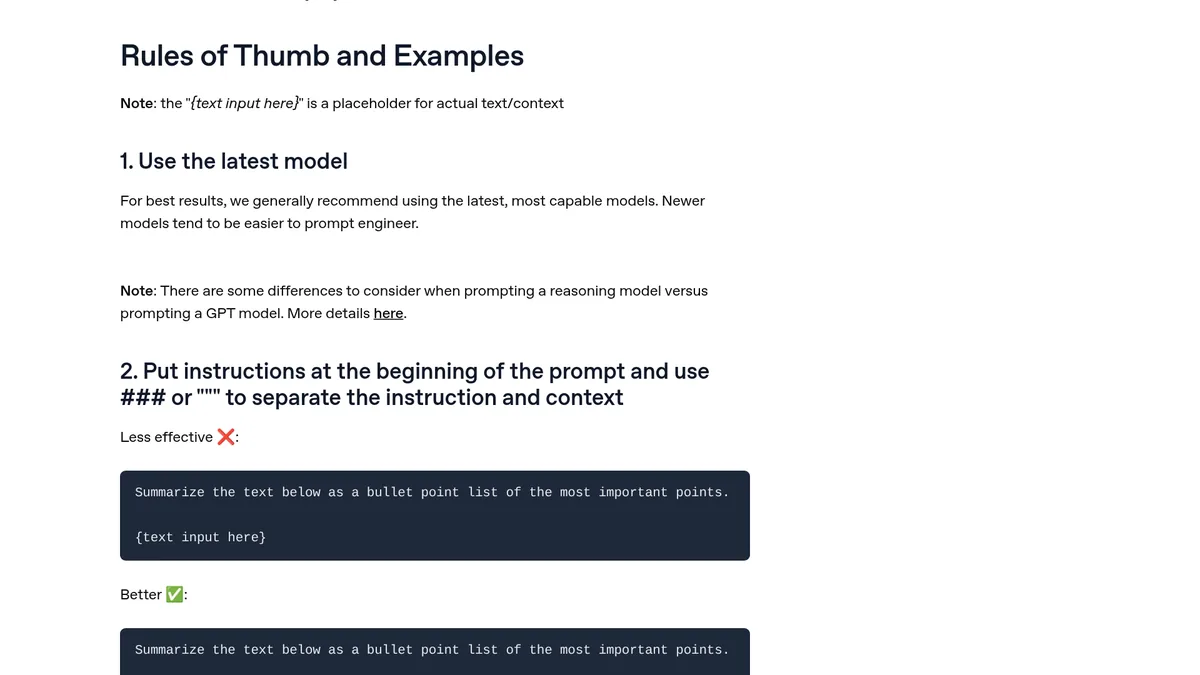
OpenAI's help center has a list of "rules of thumb." Google's Gemini guide covers the same ground. Here are 6 rules both guides back up, in plain words.
Rule 1: Put the task first, and fence off your text
OpenAI says to "put instructions at the beginning of the prompt" and to use ### or triple quote marks to separate the instruction and context. In other words, say the job first. Then paste your text inside clear marks, so the AI knows which part is the order and which part is the material.
Summarize the text below as 5 bullet points.

Text: ###
(paste your text here)
###
Google's guide suggests the same kind of thing. It says to use consistent structure, with clear marks like XML tags or Markdown headings to split up parts of a prompt.
Rule 2: Be specific
OpenAI says to be specific about "context, outcome, length, format, style." Here is its own example:
- Less effective: "Write a poem about OpenAI."
- Better: "Write a short inspiring poem about OpenAI, focusing on the recent DALL-E product launch (DALL-E is a text to image ML model) in the style of a {famous poet}"
The better one names the length, the mood, the topic, and the style. The AI has less to guess.
Rule 3: Show the format you want
OpenAI's tip is to "articulate the desired output format through examples." It adds, "Show, and tell." If you want a list with labels, type the labels in the prompt and leave blanks for the AI to fill.
Rule 4: Start simple, then add examples
OpenAI says to start with zero-shot (no examples), then few-shot (a couple of examples), and only then think about fine-tuning. Google goes further. Its guide says, "We recommend to always include few-shot examples in your prompts."
In practice, that means: try a plain ask first. If the answer is off, paste one or two samples of a good answer and ask again.
Rule 5: Cut the fluff
OpenAI calls this reducing "fluffy" and imprecise words. Its example:
- Less effective: "The description for this product should be fairly short, a few sentences only, and not too much more."
- Better: "Use a 3 to 5 sentence paragraph to describe this product."
Numbers beat vague words. The word short means different things to different people. The phrase 3 to 5 sentences does not.
Rule 6: Say what to do, not just what not to do
OpenAI's guide says, "Instead of just saying what not to do, say what to do instead." So instead of DO NOT use jargon, try Use words a 12 year old would know.
A simple prompt recipe
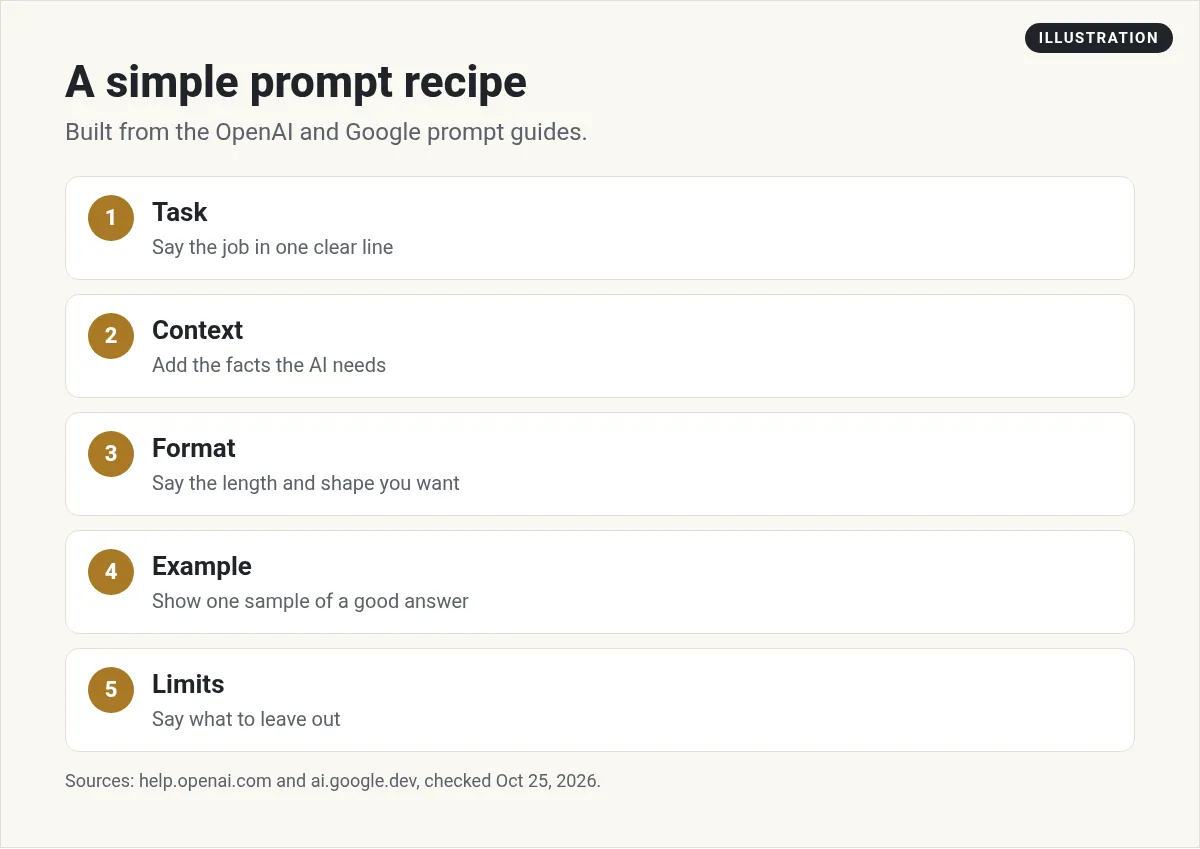
Put the 6 rules together and you get a recipe you can use for almost any task. It has five parts:
- Task. The job in one clear line.
- Context. The facts the AI needs, like who it is for.
- Format. The length and shape you want.
- Example. One sample of a good answer, if you have it.
- Limits. What to leave out, said as what to do instead.
Here it is filled in:
Task: Write an email inviting past clients to a free workshop.
Context: I run a small bookkeeping business. My clients are busy shop owners.
Format: Under 120 words. A short subject line. One clear link at the end.
Example: (paste an email you liked)
Limits: Use plain, friendly words. Keep it to one ask.
Weak prompt vs strong prompt
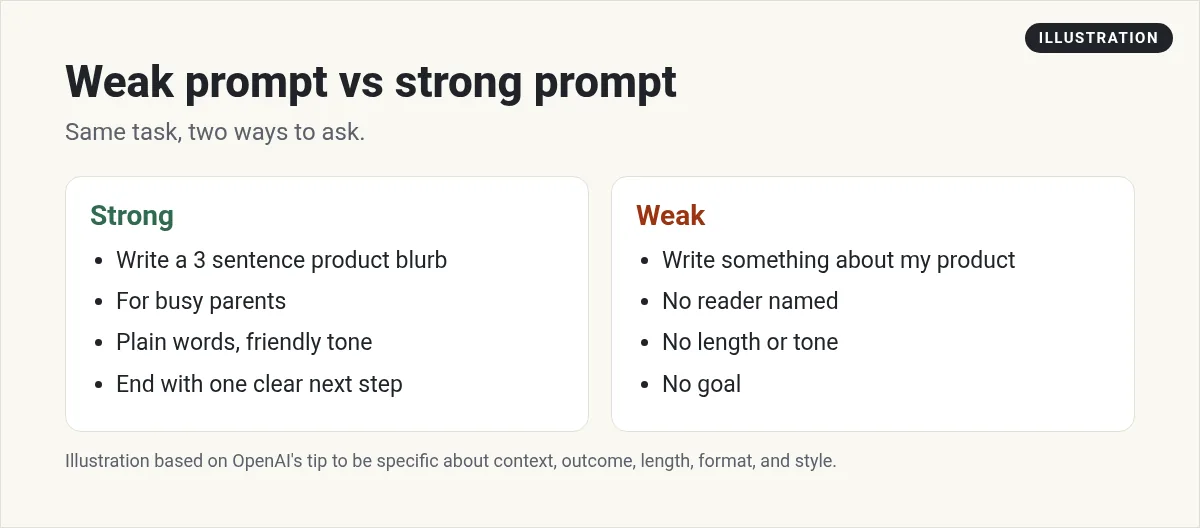
Here is a side by side. It is an illustration, not a real client case.
Weak: Write something about my product.
Strong: Write a 3 sentence product blurb for busy parents. Use plain, friendly words. End with one clear next step.
The strong prompt names the reader, the length, the tone, and the goal. Those are the exact things OpenAI's tip on being specific asks for.
My video: The five prompts I use every week for writing, feedback, and problem solving. Recorded in September 2026.
Any results mentioned in videos are not typical and are not a promise of income. Your results depend on your work and your market.
Test your prompts like a pro
Anthropic's Claude guide makes a point that is easy to skip. Before you work on a prompt, have "A clear definition of the success criteria" and "some ways to empirically test against those criteria."
In plain words: decide what a good answer looks like before you start. Then run your prompt a few times and check each answer against that list. If it fails, change one thing and try again.
A simple scorecard you can use:
- Did it follow the length I asked for?
- Did it use the format I showed?
- Are the facts right?
- Would I send this as is?
Is prompt engineering a real skill?
Yes. OpenAI, Google, and Anthropic all publish guides on it. That tells you the companies that build these tools think the way you ask matters.
But you do not need a special title to use it. Anyone who writes clear asks gets better results from AI. The same skill helps when you build apps with AI. My guide to vibe coding prompts shows how these rules work when you ask an AI to write code.
And if you are comparing chat tools, my posts on ChatGPT pricing and Claude vs ChatGPT for coding can help you pick one.
Does the AI model matter?
It does. The very first tip on OpenAI's list is to use the latest model. OpenAI says, "Newer models tend to be easier to prompt engineer." It also notes that reasoning models and GPT models can need different styles of prompt.
So if a prompt keeps failing, check which model you picked before you rewrite it. A newer model may get it right with the same words. Then go back to the 6 rules if it still misses.
Common prompt mistakes to avoid
- Too short. Write a blog post gives the AI almost nothing to go on.
- No reader. Always say who the answer is for.
- Too many jobs at once. Google's guide suggests breaking long prompts into smaller parts.
- Not checking facts. AI can sound sure and still be wrong. Check names, numbers, and dates.
- Giving up after one try. Change one thing and run it again.
Before you hit enter on a prompt
Nothing you check here is sent or saved. Download it if you want to keep it.
Meet AIM Agent
AIM Agent is an AI Chief of Staff for business owners. You give it a real task, and it brings the work back for you to review. You stay the one who approves.
Meet AIM AgentI am a co-founder of AIM Agent and have a financial interest in the product.
Frequently asked questions
What is prompt engineering in simple words?
It is learning to write clear instructions for an AI so it gives you the answer you want, the same way each time.
What is an example of prompt engineering?
Turning a vague ask, like write something about my product, into a clear one: a 3 sentence product blurb for busy parents, in plain words, that ends with one next step.
What are the basic rules of prompt engineering?
Put the task first, be specific, show the format, start simple and add examples, cut vague words, and say what to do instead of what not to do.
What is few-shot prompting?
It means adding a few examples of good answers to your prompt. Google's Gemini guide recommends always including few-shot examples.
Do I need to code to learn prompt engineering?
No. The core skill is clear writing. Coding helps only if you want to use AI inside your own apps.
How do I know if my prompt is good?
Decide what a good answer looks like first, then test the prompt a few times against that list. Anthropic's guide suggests this.
Sources
Checked October 25, 2026. Plans, prices, and rules can change.
