
Vibe Coding · Basics
Vibe coding means building software by telling an AI what you want in plain words. Here is where the term came from, how it works, and how to do it without getting burned.
A few years ago, building an app meant learning to code, or paying someone who could. Now you can type make me a booking page for my yoga class and an AI writes the code. That is called vibe coding.
The term went from a single post on X to a dictionary entry in less than a year. I checked Merriam-Webster, Collins, Google Cloud, and IBM on October 25, 2026. Here is what vibe coding means, how it works, and how to start.
Quick answer
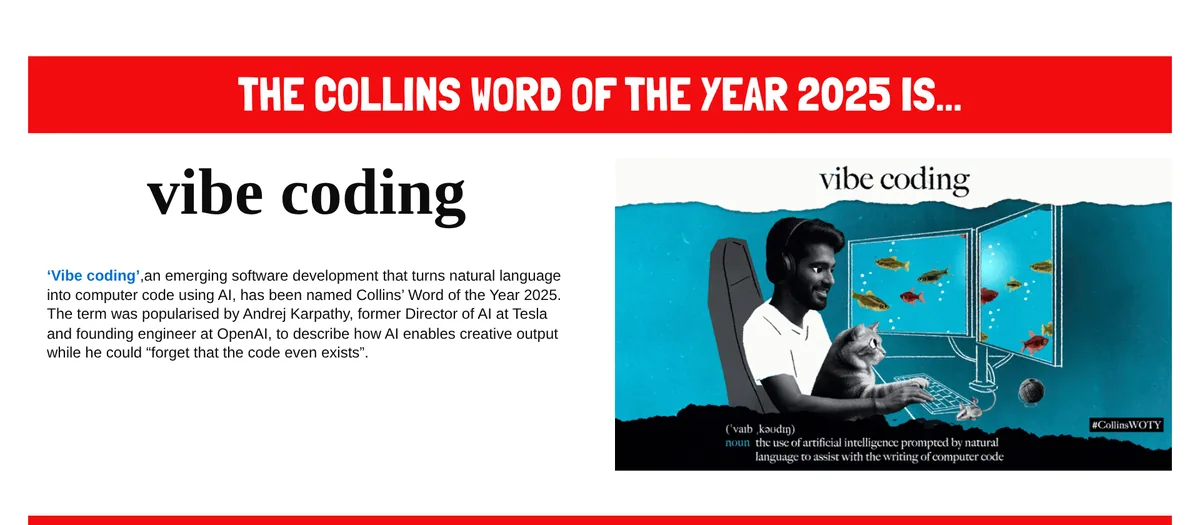
Vibe coding is building software by describing what you want to an AI in plain language, then letting the AI write the code. Merriam-Webster defines it as "writing computer code in a somewhat careless fashion, with AI assistance." AI researcher Andrej Karpathy coined the term in an X post on February 2, 2025. Collins Dictionary named "vibe coding" its Word of the Year for 2025.
Vibe coding meaning
Vibe coding is a way to make software where you talk and the AI types. You describe the app. The AI writes the code. You test it, say what to change, and repeat.
Merriam-Webster files it under slang and trending words. Its definition is short: "writing computer code in a somewhat careless fashion, with AI assistance." It also notes, "The word is more jargon than slang."
That word "careless" matters. In its first sense, vibe coding meant you do not read the code at all. You go by feel. More on that below.
Who coined vibe coding?
Andrej Karpathy did. Collins describes him as a former Director of AI at Tesla and a founding engineer at OpenAI. Merriam-Webster quotes his X post from February 2, 2025:
"There's a new kind of coding I call "vibe coding", where you fully give in to the vibes, embrace exponentials, and forget that the code even exists."
The term spread fast. By late 2025, Collins Dictionary had picked "vibe coding" as its Word of the Year.
How vibe coding works
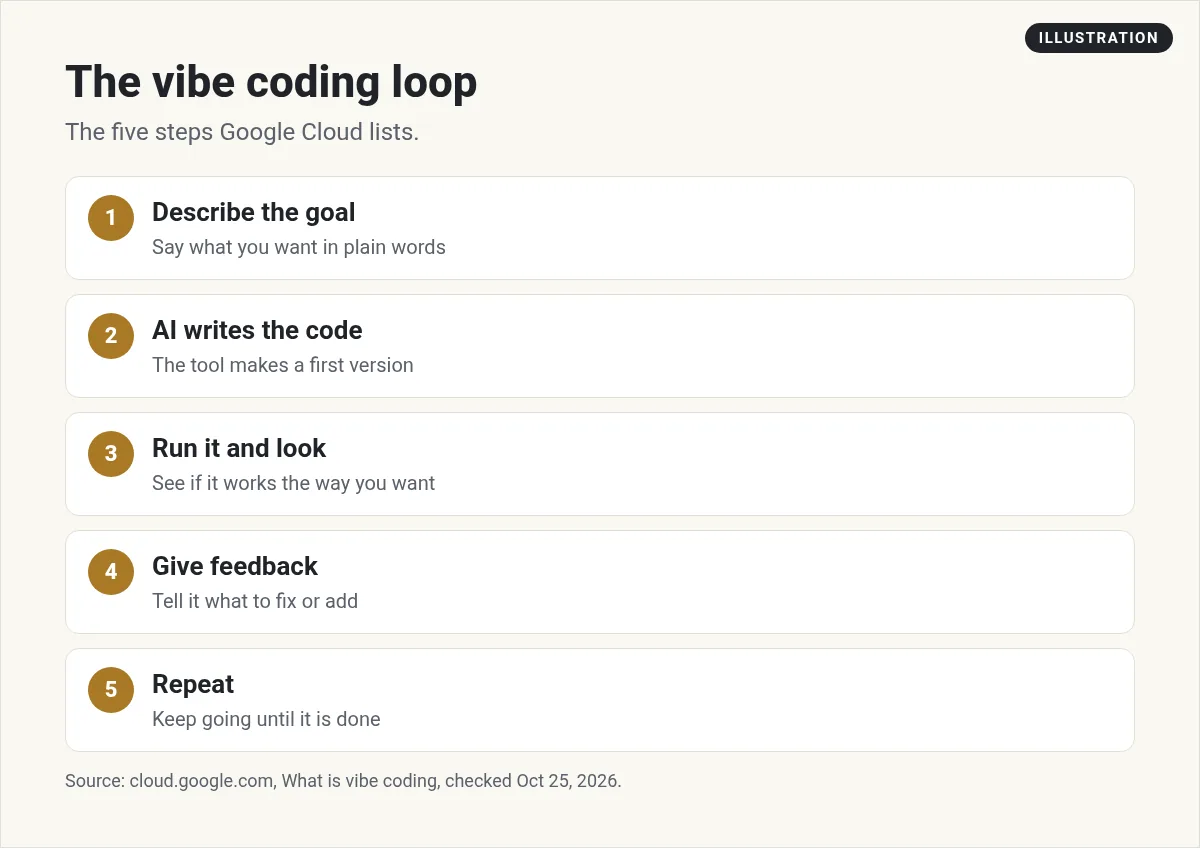
Google Cloud describes vibe coding as a loop. In plain words, it goes like this:
- Describe the goal. Tell the AI what you want, in normal words. For example: A page where clients pick a time and pay a deposit.
- The AI writes the code. It builds a first version.
- Run it and look. Open it and click around. Does it do what you asked?
- Give feedback. For example: The button is too small. Add an email reminder.
- Repeat. Keep going until it works the way you want.
Google also describes a step past the code. It calls it "vibe deploying." That means putting your app live on the web "with a single click or prompt," so real users can try it.
The two kinds of vibe coding
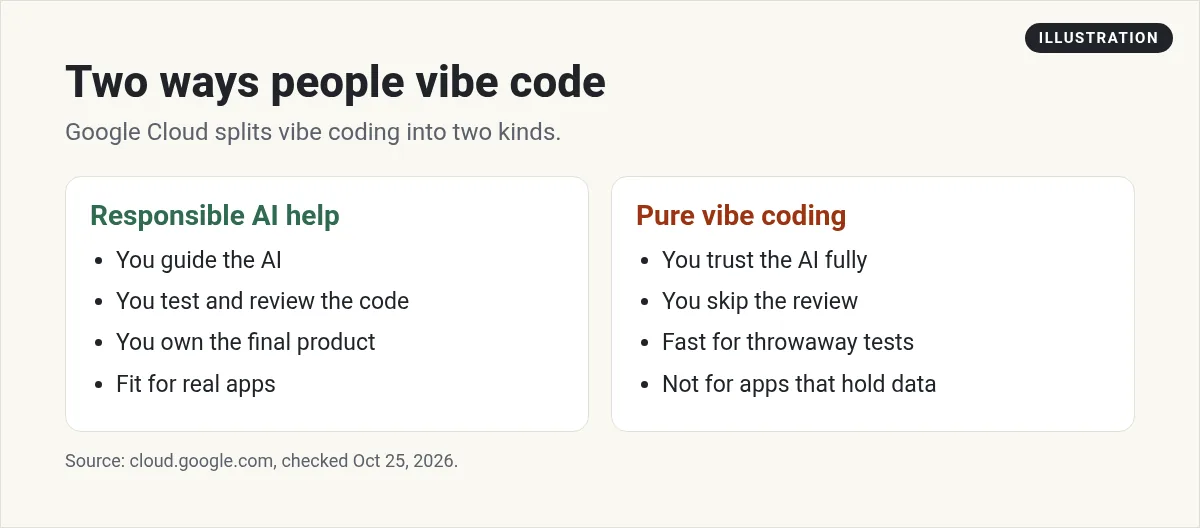
Google Cloud splits vibe coding into two kinds. Knowing which kind you are doing helps you decide how careful to be.
"Pure" vibe coding. You trust the AI fully. You do not read the code. Google says this fits "rapid ideation" or what Karpathy called "throwaway weekend projects," where speed matters more than anything.
Responsible AI-assisted development. The AI is your "pair programmer." Google says the user "reviews, tests, and understands the code it generates, taking full ownership of the final product."
Use pure vibe coding to test an idea. Switch to the responsible kind the moment real people, real data, or real money touch your app.
The risks of vibe coding
IBM puts it plainly. Like any code, AI code "still needs engineering efforts to be put in production." That means code review, testing, security checks, and more.
IBM even names a new problem: "security debt." Its point is that the more developers ship AI code without checking it, the more security holes will need fixing later.
Here is what that looks like for a beginner:
- Logins and passwords. An AI can build a login screen that looks fine but is not safe.
- Customer data. If your app stores names or emails, it must be locked down.
- Payments. Use a known payment tool. Do not let the AI invent its own checkout.
- Things you do not understand. If you cannot explain what a part does, ask the AI to explain it before you ship.
My video: My short take on why some AI software projects fail, and what to do first. Recorded in January 2026.
Any results mentioned in videos are not typical and are not a promise of income. Your results depend on your work and your market.
Who is vibe coding for?
Vibe coding is a good fit if you:
- Have an idea for a simple app or tool and do not code.
- Want to test an idea before you pay a developer.
- Run a small business and need a small custom tool, like a quote form or a client portal.
- Already code and want to move faster on the boring parts.
It also helps to know your limits. A vibe coded app is still software. Someone has to keep it working, fix bugs, and pay for hosting. If that someone is you, plan a little time each month for upkeep.
It is a poor fit if your app handles health records, money transfers, or anything where a bug could hurt someone, unless a skilled person reviews the code.
How to start vibe coding
Here is a simple first project plan:
- Pick a tiny idea. One page. One job. For example: a form that turns a client's answers into a quote.
- Write it down first. Who uses it, what they click, and what they see at the end.
- Pick a tool. Some tools run in your browser and need no setup. Others run on your computer and are aimed at coders.
- Prompt one feature at a time. Small asks are easier to test and fix.
- Test like a stranger. Try to break it. Type odd things into every box.
- Ask for a review. Have the AI explain its code and list any security risks.
For tool picks, see my guide to vibe coding tools. For how to write the asks, see vibe coding prompts. If you want to know how this differs from drag and drop builders, read vibe coding vs no code.
Where I would start: Overskill
If you want to vibe code in your browser, Overskill is one option. You describe your app and it builds it, right in the browser. You do not need to install anything to try it. Its pricing page also says you can get your code.
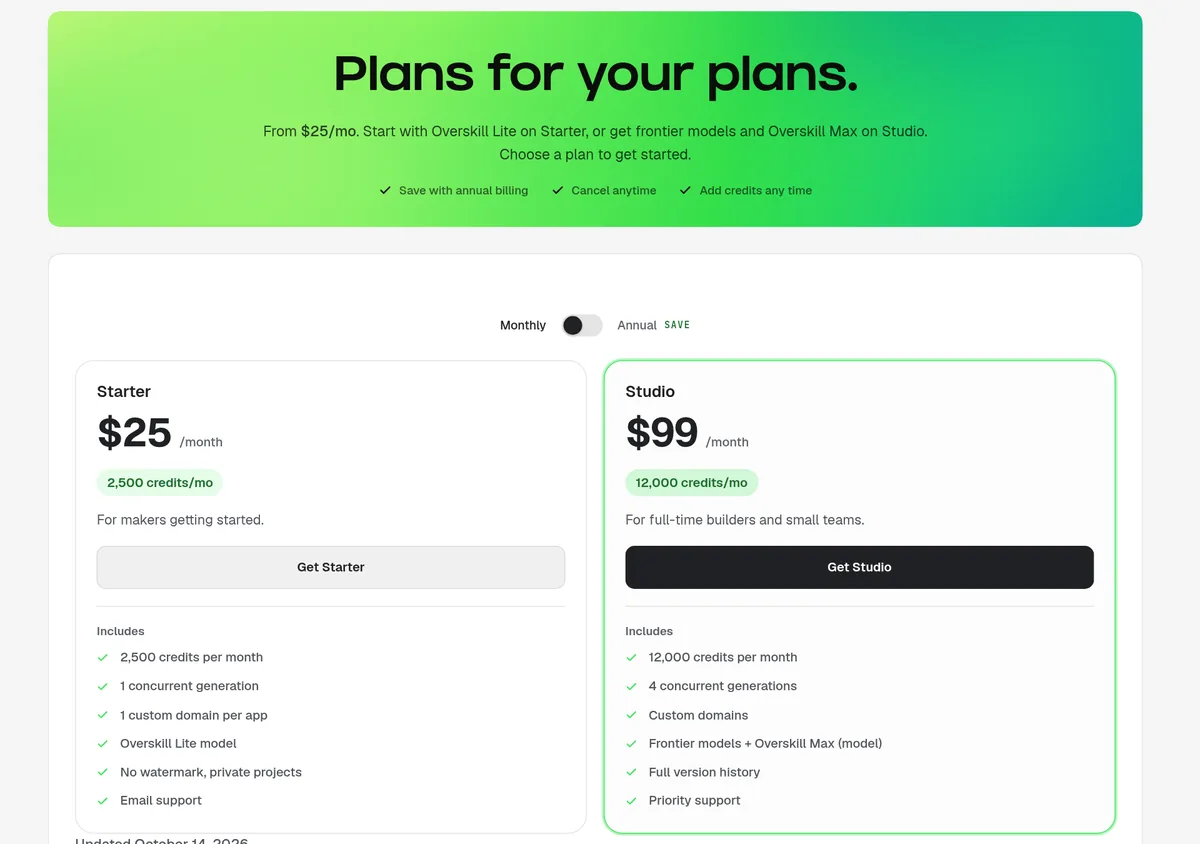
On October 25, 2026, Overskill's pricing page listed two paid plans, billed monthly:
- Starter: $25 a month. 2,500 credits a month, 1 concurrent generation, and 1 custom domain per app.
- Studio: $99 a month. 12,000 credits a month, 4 concurrent generations, and access to more AI models.
The page also says you can "Save with annual billing." With the Annual switch on, Starter was $20.83 a month billed annually ($250 a year) and Studio was $82.42 a month billed annually ($989 a year) on October 25, 2026. Look at the live page before you buy. For the full breakdown, see my Overskill pricing guide, or start with what Overskill is.
Is vibe coding here to stay?
The word made it into Merriam-Webster and won Collins Word of the Year. Google Cloud and IBM both have guides on it. That tells you the idea has gone mainstream.
What will likely change is the "careless" part. As more vibe coded apps go live, the apps that last will come from builders who test, review, and own their code, just as Google's "responsible" kind describes. If you want to turn this into a skill, see my vibe coding course guide.
Before you vibe code your first app
Nothing you check here is sent or saved. Download it if you want to keep it.
Try vibe coding in your browser
If you want to build an app by describing it, try Overskill. Start with one tiny idea and test it before you build more.
Try OverskillI earn a commission if you buy through this link. Plans and credits can change, so check the live pricing page before you buy.
Want an AI team to help run your business? Meet AIM Agent, an AI Chief of Staff for business owners. I am a co-founder of AIM Agent and have a financial interest in the product.
Frequently asked questions
What is vibe coding in simple terms?
It is building software by telling an AI what you want in plain words. The AI writes the code, you test it, and you ask for changes.
Who coined the term vibe coding?
Andrej Karpathy, an AI researcher, coined it in an X post on February 2, 2025.
Is vibe coding a real word?
Yes. Merriam-Webster lists it as a slang and trending term, and Collins Dictionary named vibe coding its Word of the Year for 2025.
Is vibe coding safe?
It can be, if you test and review the code. IBM warns that AI code still needs review, testing, and security checks before it goes live.
Do I need to know how to code to vibe code?
No, not to start. But you should learn to test your app and ask the AI to explain its code, so you can catch problems.
How much does Overskill cost for vibe coding?
On October 25, 2026, Overskill listed Starter at $25 a month and Studio at $99 a month, billed monthly. Annual billing is offered, but the annual price was not shown.
Sources
Checked October 25, 2026. Plans, prices, and rules can change.
- Merriam-Webster: vibe coding
- Collins Dictionary: Word of the Year 2025
- Google Cloud: What is vibe coding? (last updated 10/13/2026)
- IBM: What is vibe coding?
- Overskill: Pricing page, overskill.com/pricing (updated October 14, 2026)
