
Automation · AI Basics
Agentic AI is AI that can plan steps and take action toward a goal, with less hand holding. Here is what that means, how it works, and how to try it safely.
You have heard the word "agentic" in AI news, ads, and job posts. It sounds like hype. But the idea behind it is simple, and it matters for anyone who uses AI at work.
I read how IBM, Google Cloud, and AWS define agentic AI. I checked their pages on October 25, 2026. Here is what it means in plain words, how it works, where it is used, and what to watch out for.
Quick answer
Agentic AI is AI that can work toward a goal on its own, with limited supervision. IBM defines it as "an artificial intelligence system that can accomplish a specific goal with limited supervision." Instead of only answering a prompt, it plans steps, uses tools like email or a calendar, checks the result, and adjusts. Google Cloud calls AI agents "the building blocks of agentic AI."
What does agentic AI mean?
The word "agentic" comes from "agency." It means the power to act. IBM says the term refers to a model's "capacity to act independently and purposefully."
Here is how three tech companies define it:
- IBM: "Agentic AI is an artificial intelligence system that can accomplish a specific goal with limited supervision."
- AWS: "Agentic AI is an autonomous AI system that can act independently to achieve pre-determined goals."
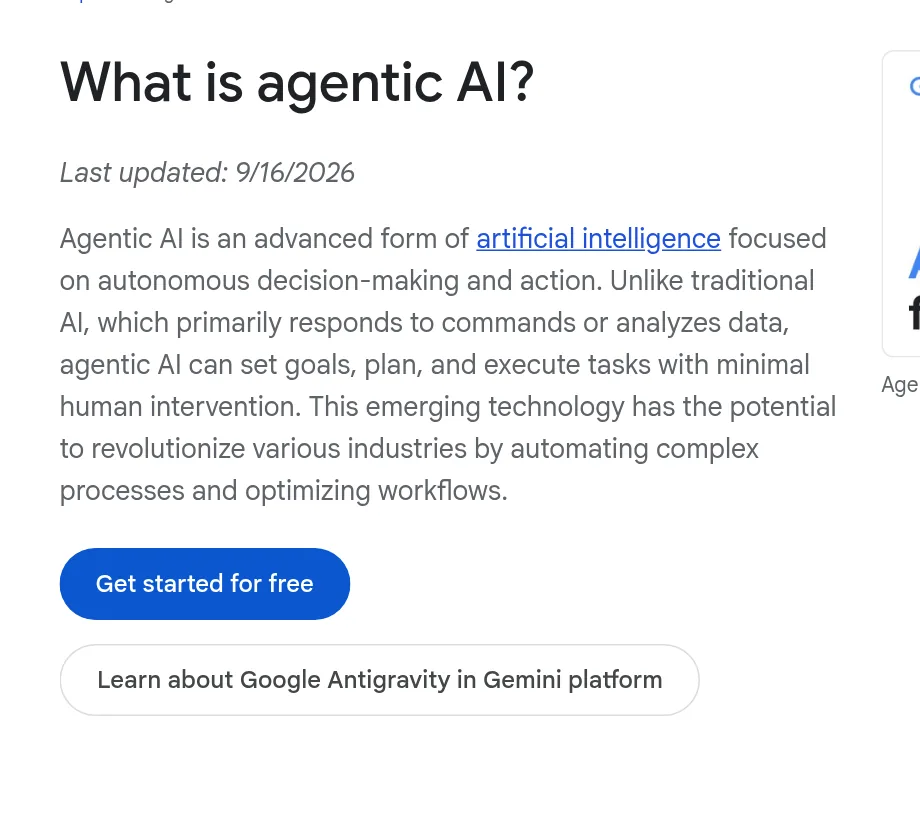
- Google Cloud: agentic AI is "an advanced form of artificial intelligence focused on autonomous decision-making and action."
The common thread is simple. You give it a goal, not just a question. It figures out the steps and does them.
How agentic AI works, in 5 steps
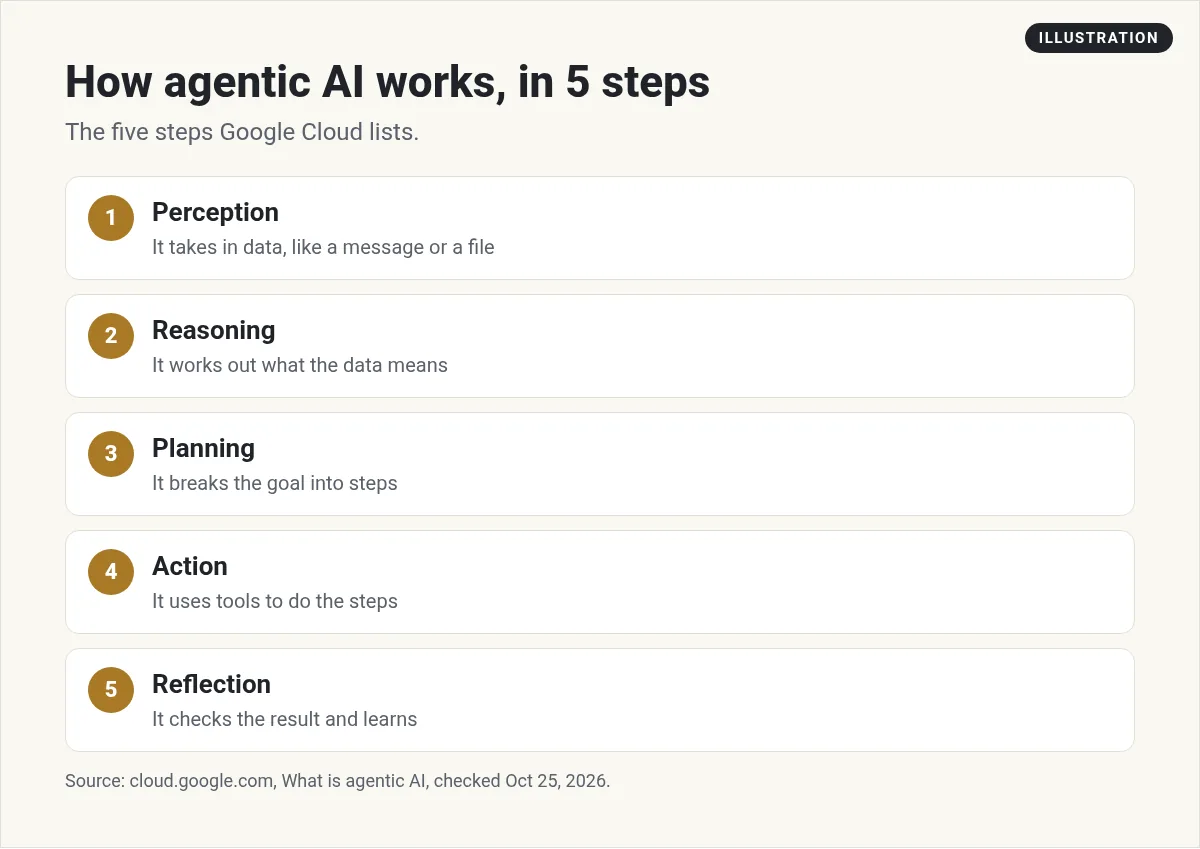
Google Cloud breaks the process into five steps. Here they are in plain words:
- Perception. It gathers information, like text, images, or data from a database.
- Reasoning. It uses a large language model (LLM) to understand what it found. Google's example: to schedule a meeting, it reads emails to find who should come and when they are free.
- Planning. It sets goals and breaks them into smaller steps.
- Action. It does the steps. That can mean doing tasks, making choices, or working with other systems.
- Reflection. It checks if the action worked, and uses that to adjust next time.
That last step is the key. A plain chatbot gives an answer and stops. An agentic system keeps going until the goal is met, or until it needs your help.
Agentic AI vs generative AI vs AI agents
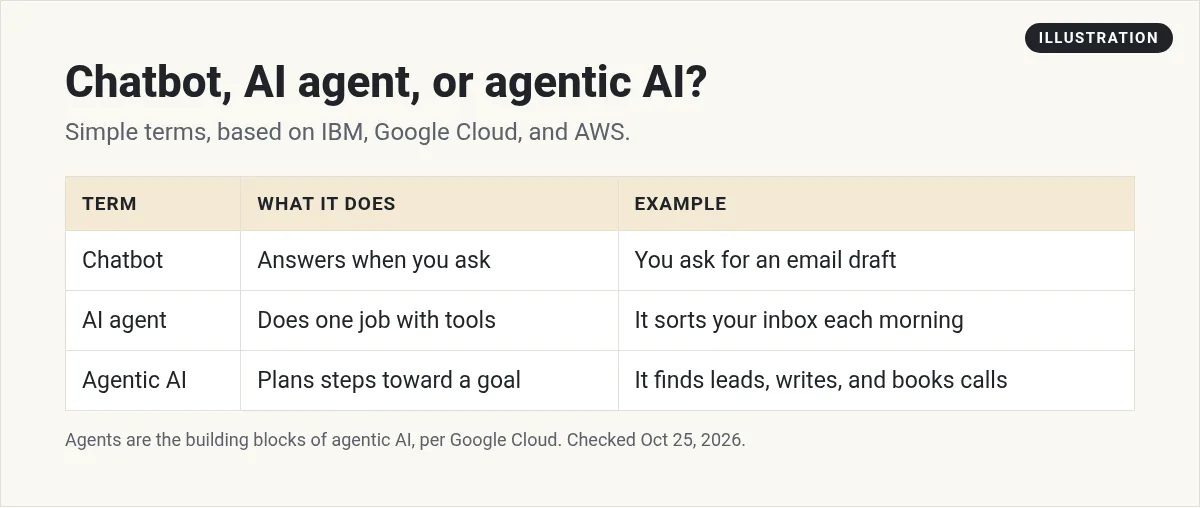
These terms get mixed up. Here is how Google Cloud sorts them.
Generative AI makes new content, like text, images, or code, from a prompt.
Agentic AI is "a subset of generative AI," per Google Cloud. It uses an LLM as a "brain" to take actions through tools. Google's example: generative AI could create marketing materials. Agentic AI could then post them, track how they do, and adjust the plan.
AI agents are the parts. Google says, "Think of AI agents as individual tools in a toolbox, while agentic AI is the coordinated use of those tools to build an entire house." One agent may do one task. An agentic system can run several agents to handle a bigger job.
IBM says the same idea another way. In a multiagent system, "each agent performs a specific subtask" toward the bigger goal.
Real examples of agentic AI
Here are examples the source pages give. I kept them close to how each company wrote them.
- Shift scheduling (AWS). If a worker calls in sick, the agent can message other workers and fix the schedule, while still meeting the project's needs.
- Customer service (Google Cloud). Agentic AI can handle questions and fix issues, so human staff can take the harder problems.
- Software (Google Cloud). It can help write, debug, and test code.
- Finance (Google Cloud). It can help with fraud checks and risk reviews by reading market and customer data.
- Health care (AWS). A treatment planning agent can work with several medical teams to build one care plan.
Now a small business version. Say a lead fills out a form on your site. An agentic setup could read the form, look up the person, write a reply, offer times from your calendar, and add the lead to your CRM. You set the rules. It does the steps.
That is the kind of job I cover in my guide to an AI sales agent.
How to try agentic AI yourself
You do not need to be a coder to try a small agent. Two tools make it simple to start:
- n8n. Its docs say the AI Agent node lets you "connect a chat model and one or more tools, and the agent decides which tools to call to complete a task."
- Zapier Agents. Zapier's page says you can give agents company knowledge and have them work across "9,000+ apps."
Here is a simple starter plan:
- Pick one boring task. Something you do every week, like sorting new leads.
- Write the goal in one line. For example: Reply to each new lead within 5 minutes and offer a call.
- Give it only the tools it needs. Email and calendar. Not your bank account.
- Test with fake data first. Watch every step it takes.
- Keep a human check. Approve its replies at first. Loosen up only when it is right again and again.
For a full walk through, see my guide on how to build an AI agent. If you want to use n8n, start with what n8n is.
The risks of agentic AI
More power means more ways things can go wrong. IBM puts it plainly. It warns that "this autonomous nature can bring serious consequences" if agentic systems go off the rails. It adds that "the usual AI risks apply, but can be magnified."
Google Cloud lists things to plan for:
- Clear goals. Know the exact problem the agent should solve.
- Good data. Agents rely on data that is accurate, complete, and up to date.
- Ethics. Agents can make choices that affect people. Watch for bias.
- Security. Google says these systems "may be vulnerable to cyber attacks" and need guardrails.
- Explainability. You should be able to see why it made a choice, so you can fix it when it goes wrong.
My own rules for beginners are simple. Start small. Limit access. Log every action. And never let an agent spend money or send messages to customers without a review step until you trust it.
Is agentic AI just hype?
Some of the buzz is marketing. Not every tool with "agent" in the name can plan and act on its own. Use this quick test:
- Can it use tools, like email, a calendar, or a spreadsheet?
- Can it take more than one step without you typing each one?
- Does it check its own work and try again?
If the answer to all three is yes, it is agentic in the sense IBM, Google, and AWS describe. If it only chats, it is a chatbot with a new label.
What agentic AI means for you
You do not need to build these systems to benefit. The useful skill is knowing which tasks to hand off, how to write a clear goal, and how to check the work.
That skill is the same one that makes you good with any AI tool. Be clear about the goal. Give the right context. Review the output. If you want to get better at that, start with my guide to writing clear prompts.
Before you set up your first AI agent
Nothing you check here is sent or saved. Download it if you want to keep it.
Learn to put AI to work
Want to see how I use AI to save hours on real business tasks? Join my free AI workshop. I show the tools and the steps.
Join my free AI workshopFree to join. No credit card needed.
Frequently asked questions
What is agentic AI in simple terms?
It is AI that can work toward a goal on its own. It plans steps, uses tools, checks the result, and adjusts, with limited supervision.
What is the difference between agentic AI and generative AI?
Generative AI makes content from a prompt. Google Cloud calls agentic AI a subset of generative AI that uses an LLM to take actions through tools.
What is the difference between agentic AI and AI agents?
Google Cloud says AI agents are the building blocks of agentic AI. One agent may do one task. Agentic AI coordinates agents to reach a bigger goal.
What is an example of agentic AI?
AWS gives shift scheduling. If a worker is out sick, the agent can message other workers and fix the schedule while still meeting the project's needs.
Is agentic AI safe?
It can be risky. IBM warns the usual AI risks can be magnified. Start small, limit what it can access, log its actions, and keep a human review step.
Can I build an agentic AI workflow without coding?
Yes. Tools like n8n and Zapier Agents let you connect a chat model to tools like email or a calendar without writing code.
Sources
Checked October 25, 2026. Plans, prices, and rules can change.
