
Grok Bot · Affiliate Marketing
Grok Bot can do a lot of the slow work behind affiliate content: research, drafts, and tracking. Here is the workflow I would use, and the parts you should never hand to a Bot.
Grok Bot for affiliate marketing is a hot search right now, and a lot of the videos promise easy money. I am not going to do that. What I will show you is how Grok Bot can take the slow, boring parts of affiliate work off your plate, while you keep the parts that protect your name.
I write a lot of reviews and comparisons on this site, and some posts have affiliate links. I read the official Grok Bot docs on October 28, 2026, and watched the most useful recent tutorials. Here is the honest version.
TL;DR
Grok Bot can research products and program terms, gather real reviews with sources, draft outlines and posts in your voice, and track your links in a sheet, on a shared cloud computer. Set up one Bot per job, end every task at a review point, and keep publishing behind approval. You always pick the programs, check every fact and price, and add clear disclosures. No tool makes affiliate income automatic. AIM Agent gives you a ready-made content and marketing team inside Grok Bot.
First, an honest word about affiliate marketing and AI
Affiliate marketing works when people trust your advice. AI can help you make more content, faster. But if the content is wrong or feels fake, you lose the trust, and the links stop working for you.
So my rule is simple. The Bot does the research and the first draft. I check the facts, add my real experience, and decide what goes live. Grok Bot is a great fit for that rule, because its docs are built around it. They say to keep "sending, publishing, purchasing, and production changes behind approval."
I also will not tell you how much money you can make. Results depend on your niche, your audience, and your work. Anyone who promises a number is guessing.
Why Grok Bot fits affiliate work
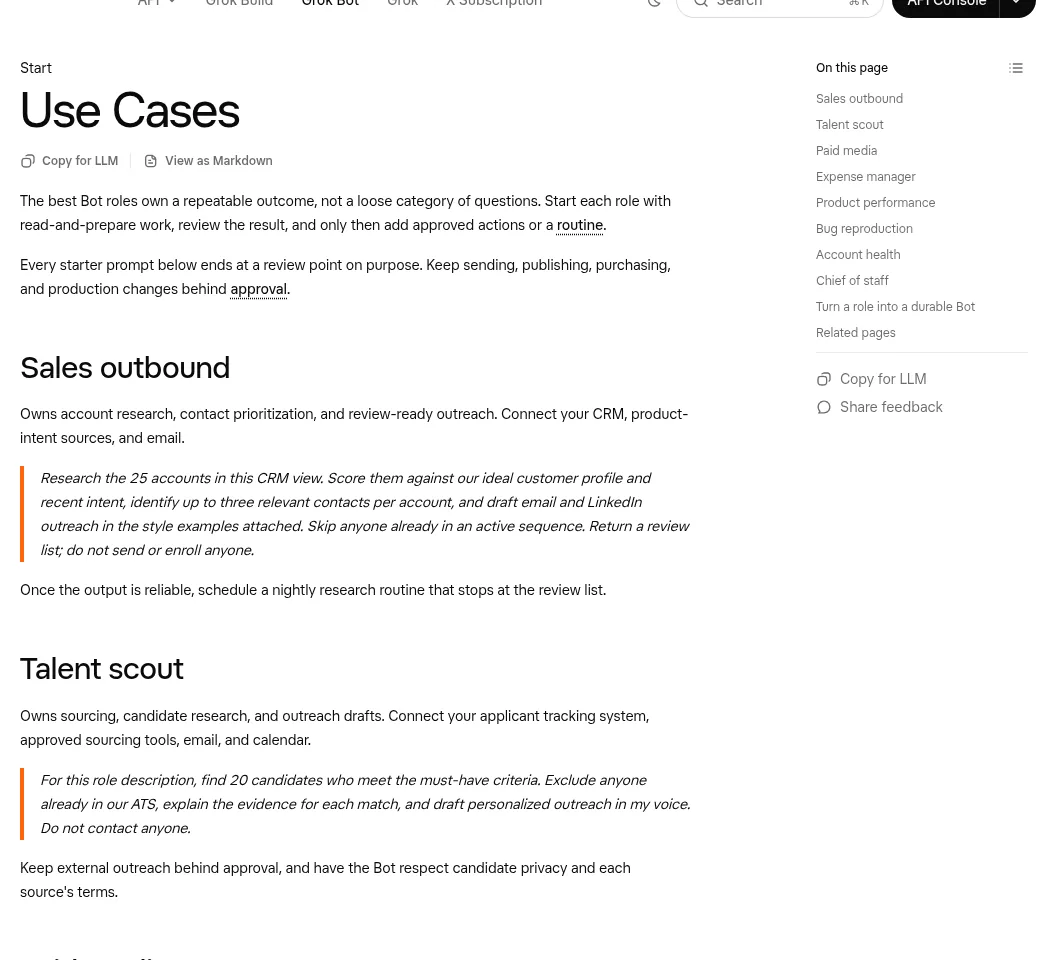
Affiliate work has a lot of small, repeatable jobs. That is exactly what the docs say Bots are best at: "The best Bot roles own a repeatable outcome, not a loose category of questions."
A few Grok Bot features help a lot here:
- A real browser. Your Bots share one cloud computer with a browser, so a Bot can open product pages and read them the way you would. See Grok Bot computer use.
- Skills. You teach it your review format once and it reuses it. See Grok Bot skills.
- Routines. It can check things on a schedule while your laptop is closed. See Grok Bot routines.
- Memory. It remembers your niche, your voice, and your rules. See Grok Bot memory.
My affiliate content loop
Here is the loop I would build. Each step ends with something you can review.
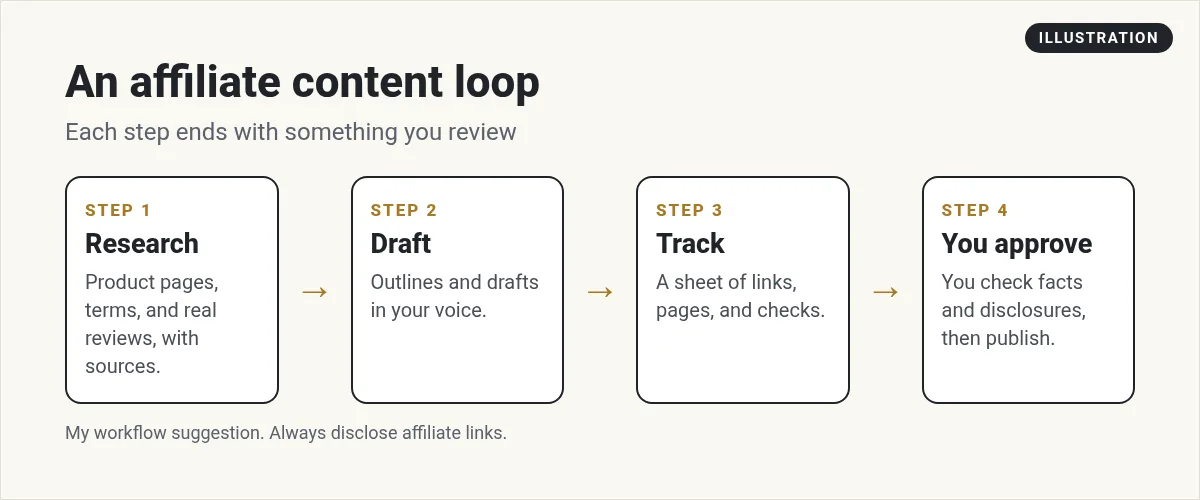
- Research. A research Bot reads the product page, the pricing page, and the affiliate program terms. It also gathers real user reviews and links every claim to a source.
- Draft. A content Bot turns the research into an outline, then a draft, in your voice. It marks anything it could not confirm.
- Track. A tracking Bot keeps a sheet of every post, every link, and the date the facts were last checked.
- You approve. You read the draft, check the facts, add your own experience, add the disclosure, and publish.
In his full course video, Brock Mesarich shows a team of agents in Grok Bot, including a content bot and a brand partnership agent. That is the same idea: one Bot per job, and you in charge.
The Bots I would set up
| Bot | Its one job | Where it stops |
|---|---|---|
| Product Researcher | A fact sheet for one product, with sources | Returns the sheet |
| Program Checker | Reads affiliate program terms and rules | Returns a summary |
| Content Drafter | Outlines and drafts in my voice | Returns a draft, never posts |
| Link Tracker | Keeps the sheet of posts and links | Flags broken links |
| Price Watcher | Checks product pages for changes | Tells me what changed |
Start with just one. The Product Researcher is the best first Bot because it saves the most time and is easy to check.
Step by step: a product research Bot
- Create the Bot. Choose the + button, then Create a Bot, and name it Product Researcher.
- Tell it your niche and your rules. For example: "I review AI tools for small business owners. Only use official pages and real user reviews. Never guess a price."
- Give it one product. Use the prompt below.
- Check the result. Open every source link. Fix anything wrong and tell the Bot why.
- Save it as a skill. Once the fact sheet looks right, ask it to save the method so every product gets the same format.
Research this product for a review. Read the official product page, the pricing page, and the help docs. List the main features, who it is for, and its limits, with a link for each fact. Then find 5 real user reviews and sum up the common praise and complaints. Mark anything you could not confirm. Do not write the review yet.
Notice the last line. The Bot stops at a fact sheet. That gives you a clean place to check its work before anything turns into content.
Watching prices and pages
Prices and plans change all the time. An old price in a post is one of the fastest ways to lose a reader's trust.
Brock shows a Deal Scout idea in his course: an agent that watches a product page and pings you when the price changes, using a scraping tool called Firecrawl. You can do a simple version with a weekly routine:
Every Monday, open the pricing pages in my tracking sheet. Compare them with the prices in the sheet. List anything that changed, with the link. Do not edit any post.
Then you update the posts yourself. I keep a "facts checked on" date on my reviews for this reason.
From the Brock Mesarich channel (not mine): Brock Mesarich's full Grok Bot course covers a team of agents, a content agent, a Deal Scout price watcher, routines, memory, and skills.
What the Bot does vs what you always do
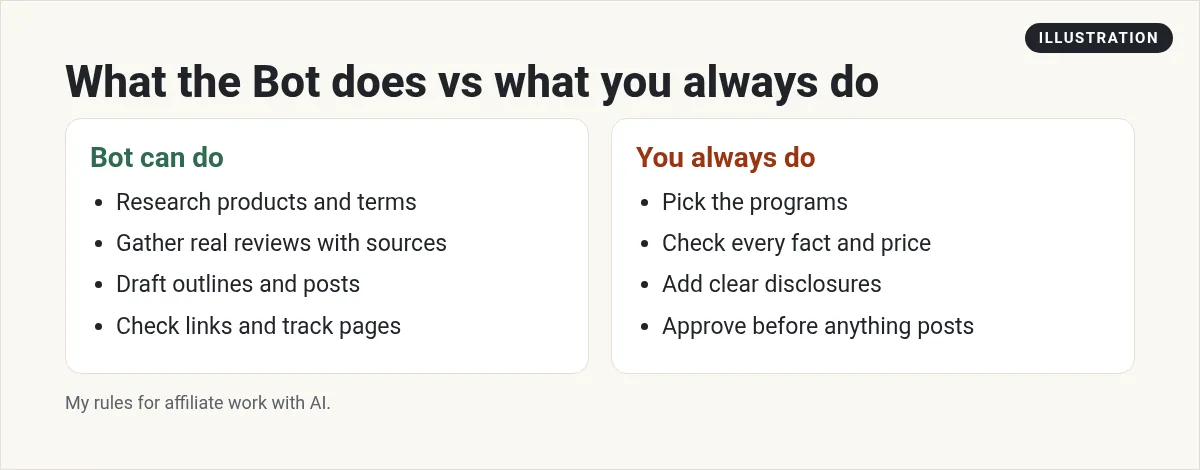
This split is the heart of the whole workflow. Here are the jobs I would never hand to a Bot:
- Picking the programs. Only promote things you would tell a friend to buy.
- Checking every fact and price. The Bot can be wrong. Your name is on the post.
- Adding the disclosure. Tell readers clearly, right next to the link or the recommendation, when a link pays you. Plain words work best, like "I get commissions for purchases made through links in this post." The words "affiliate link" alone may not be clear to readers. Follow the FTC's rules on endorsements in the US. The FTC explains this in its guide called FTC's Endorsement Guides: What People Are Asking.
- Adding your real experience. Readers want to know what you saw, not a summary of a sales page.
- Publishing. Keep publishing behind approval, always.
Also, read each program's rules. Some programs limit where and how you can post links. Your Program Checker Bot can summarize the rules, but you make the call.
Mistakes to avoid
- Publishing AI drafts as is. They read flat and can have errors. Add your voice and your proof.
- Copying claims from videos. Many videos repeat old prices or big promises. Go to the official page.
- Letting a Bot post for you. Even a good Bot will get something wrong one day.
- Too many routines. Every run uses usage. A weekly price check is plenty for most sites.
- Weak prompts. Say the outcome, the sources, the rules, and the stop point. My Grok Bot prompts post shows how.
A marketing team that is already set up
Building a research Bot, a content Bot, and a tracking Bot that work well together takes a lot of trial and error. You have to write the skills, set the stop points, and teach each one your voice.
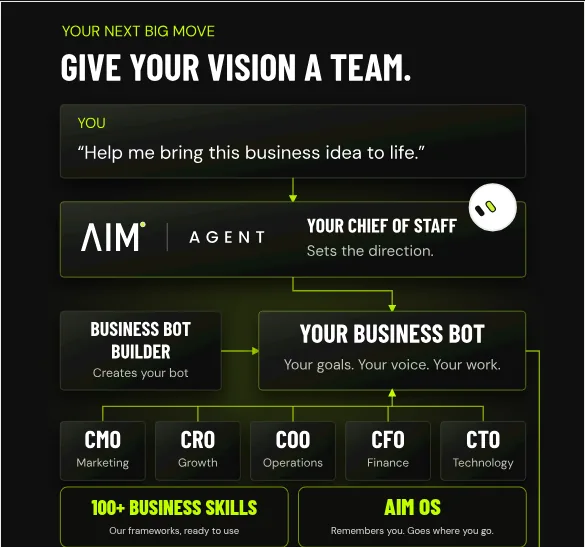
AIM Agent is an AI Chief of Staff for business owners. It comes with an AI C-suite (COO, CMO, CFO, CRO and CTO), a Business Bot Builder and 100+ business skills, and it runs on AIM OS, a private vault that holds your notes and memory. AIM Agent is a ready-made AI business team that works inside Grok Bot, so you skip the setup and get to work.
Here is what you get:
- An AI Chief of Staff that helps you plan and run your business
- An AI C-suite: COO, CMO, CFO, CRO and CTO
- A Business Bot for each business or project. Give it a real task and it brings the work back for you to review
- 100+ business skills for content, offers, research and more
- A step by step setup guide, with email support until your first bot finishes a real task
AIM Agent gives you an AI Chief of Staff and an AI C-suite, including a CMO, plus a Business Bot Builder and 100+ business skills, so you start with a team that already knows marketing and content work.
Where to go next
If you make videos or posts as well, see Grok Bot for content creators. If you run a business behind your content, see Grok Bot for small business. New to the app? Start with the beginner tutorial. I also show real AI workflows in my free MakerAI workshop.
Start with a content and marketing team
AIM Agent gives you an AI Chief of Staff, an AI C-suite, a Business Bot Builder, and 100+ business skills inside Grok Bot.
See AIM AgentFrequently asked questions
Can Grok Bot do affiliate marketing for me?
It can do much of the slow work, like research, drafts, and link tracking. You should still pick programs, check facts, add disclosures, and approve what goes live.
Will Grok Bot make me money with affiliate links?
No tool can promise that. Results depend on your niche, audience, and work. Grok Bot can save you time on research and drafts.
What is the best first Bot for affiliate work?
A product research Bot that makes a fact sheet with sources. It saves the most time and is easy to check.
Can Grok Bot watch for price changes?
Yes, with a routine that opens pricing pages on a schedule and tells you what changed. Keep the edits to your posts in your own hands.
Should I let Grok Bot publish posts?
I would not. The docs recommend keeping publishing behind approval. Let it draft, and you publish.
Do I still need to disclose affiliate links?
Yes. Tell readers clearly, close to the link, when a link pays you, and follow the FTC's endorsement rules if you are in the US.
Is there a faster way to get a content team?
AIM Agent gives you an AI Chief of Staff, an AI C-suite, a Business Bot Builder, and 100+ business skills that work inside Grok Bot.
Sources
Checked October 28, 2026. Plans, prices, and rules can change.
